Osmanthus Tea: Flowers, Tea Blends and How to Brew Each
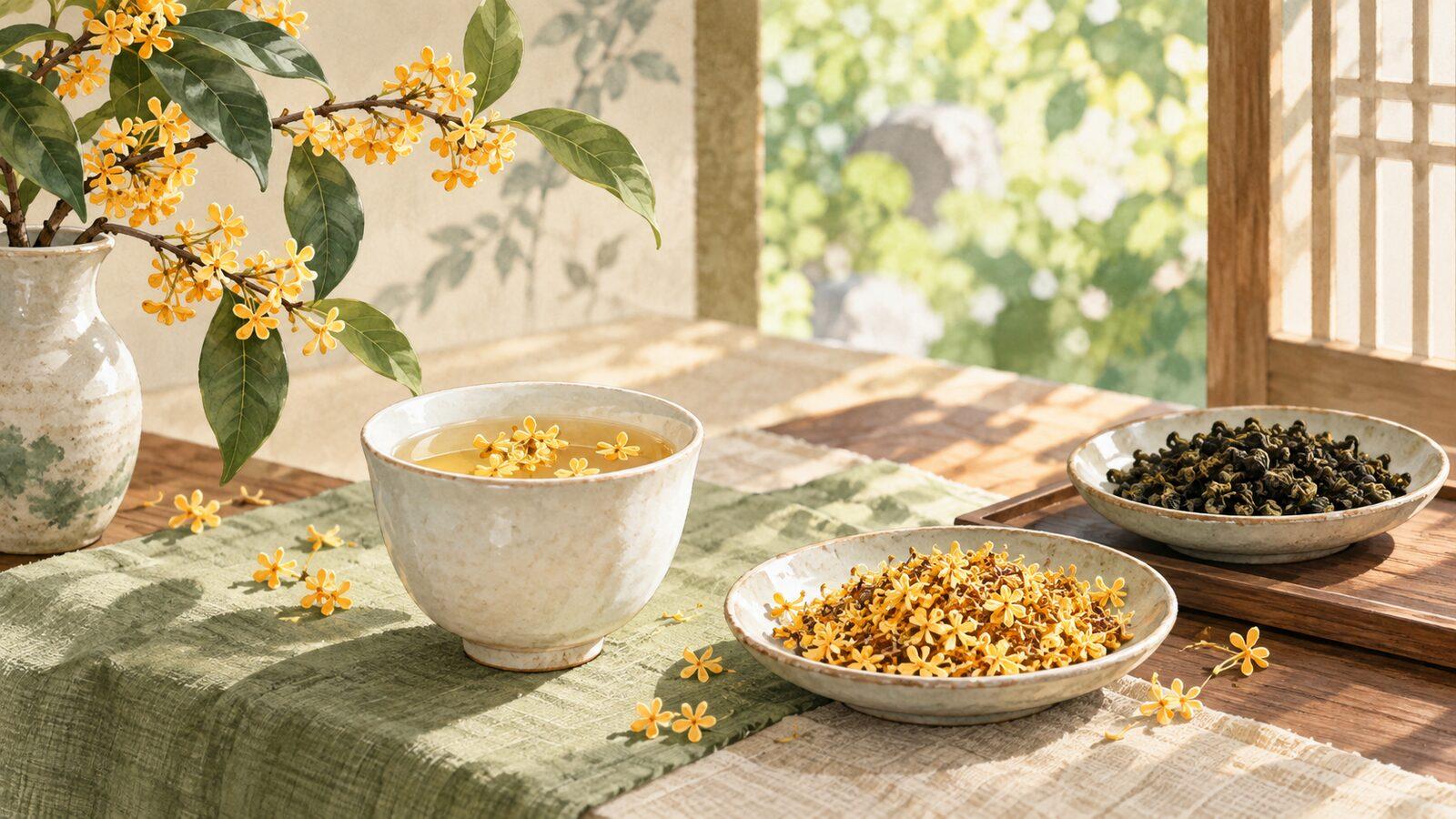
The label says osmanthus tea. Inside one packet are only small dried flowers. Inside another are tea leaves scented or mixed with those flowers. They may smell related, but they do not necessarily need the same water temperature, brewing time, or caffeine description. Before heating water, turn the packet over and read the ingredients.
This guide separates pure osmanthus flower tea from green, oolong, and black tea blends. It gives a measured first cup for loose flowers, then shows how to adapt when the product includes tea leaves. For another floral comparison, jasmine tea has its own ingredient and brewing questions; neither name alone tells you the full recipe.
What is in an osmanthus tea packet?
Osmanthus flowers can be dried and infused on their own or used alongside tea leaves. Red Blossom Tea's osmanthus flowers are sold as pure flowers for brewing; the seller describes a honey-like, tropical-fruit aroma. Those are its product notes. Another harvest or blend may give you a different impression, and the taste of the cup depends on how much flower you use.
For a pure-flower product, the ingredient list should name osmanthus flowers without green, oolong, black, or other tea leaves. Red Blossom describes its pure flowers as naturally caffeine-free. That description applies to a product made only of those flowers. If a packet lists tea leaves, treat it as a tea blend and read its caffeine and brewing information separately.
Buy flowers labeled for use in food or tea. A flowering ornamental plant in a garden is not automatically a prepared, identified food-grade ingredient. This guide does not provide foraging instructions or claim that every plant sold under a similar common name is suitable for a drink. A clear package gives you an ingredient list and, ideally, a brewing method to test.
Pure flowers or a tea-leaf blend?
The difference is easier to see in a short ingredient comparison than in a poetic tasting description:
| Product type | Ingredient check | First brewing decision | Caffeine assumption |
|---|---|---|---|
| Pure osmanthus flowers | Flowers only | Red Blossom: 82°C (180°F), 2 minutes | Red Blossom's pure flowers are described as caffeine-free |
| Osmanthus green tea | Green tea leaves plus flowers or floral scent | Start like green tea: 75°C (170°F), 2 minutes | Contains tea-leaf caffeine |
| Osmanthus oolong | Oolong leaves plus flowers or floral scent | Start like a light oolong: 85-90°C (185-195°F), 3 minutes | Contains tea-leaf caffeine |
| Osmanthus black tea | Black tea leaves plus flowers or floral scent | Start like black tea: 93-100°C (200-212°F), 3 minutes | Contains tea-leaf caffeine |
Package directions for the exact product in your hand come before the table: if the maker gives a temperature, dose, and time, start there. The table's numbers are for packets that give none, and they come from the base tea, not the flower. Even two oolongs can be packed and prepared differently. If the label only says “osmanthus tea,” ask the seller what else is in it before borrowing a pure-flower recipe.
Flowers may be added to a tea for aroma, or a tea may be described as osmanthus-scented. The front label does not always say which. Read the actual ingredients when they are available, and avoid guessing at an ingredient that is not listed. Flavor can guide your own next cup, but it cannot prove what was packed.
Brew pure osmanthus flowers: one measured first cup
For its pure osmanthus flowers, Red Blossom gives a small-cup recipe: 1 gram of flowers per 2 US fluid ounces of water, about 59 ml, at 180°F (about 82°C), for two minutes. Keep the small water volume in mind. This is a concentrated recipe for that seller's flowers, not “1 gram per large mug.”
To reproduce that first cup:
- Weigh 1 gram of labeled food-grade flowers. The blossoms are light, so a scale is more dependable than an unspecified spoonful.
- Measure 2 US fluid ounces, about 59 ml, of water. Use a small heat-safe cup or brewing vessel so the flowers can be submerged.
- Bring the water to roughly 180°F, or 82°C, and pour it over the flowers. Start a two-minute timer as you pour.
- Strain completely into a second cup. Taste the aroma and strength before sweetening or adding another ingredient.
- Write down the flower amount, water amount, temperature, and time. That note makes your second attempt a comparison rather than a guess.
For a larger tasting amount at a similar ratio, use 3 grams in 180 ml, a rounded scaling of 1 gram per roughly 59 ml (the exact figure is about 177 ml). Use a vessel large enough for it and keep the two-minute time as your initial test.
If the first cup is too faint for your taste, change only one variable next time: a little more flower or a little more time. If the aroma is too forceful, try less flower while keeping the temperature and time steady. Harvests differ, so your own packet decides the final ratio.
Brew a green, oolong, or black tea blend
When a blend contains tea leaves, the leaf sets the brew, not the flower. Boiling water that suits a black tea can scorch a green one, so do not apply 180°F for two minutes to every osmanthus-labeled packet just because the flower seller uses it for pure flowers. If the package gives a full recipe, start there. If it does not, start from the base tea with the same numbers our brewing guides use:
- Osmanthus green tea: water at about 75°C (170°F), 1 teaspoon per 240 ml (8 oz), 2 minutes for the first cup. Green tea turns bitter quickly past 3 minutes; a second infusion can take 2.5 minutes with the water a few degrees hotter. More in the green tea brewing guide.
- Osmanthus oolong: if the leaves look green and tightly rolled, brew it as a light oolong: 85-90°C (185-195°F), 1 teaspoon per 240 ml, 3 minutes, adding a minute for each of two or three re-steeps. A darker, roasted base takes hotter water, 90-96°C (195-205°F). For gongfu brewing, use 5-8 g per 100 ml and 30-60 second steeps. More in mastering oolong tea.
- Osmanthus black tea: 93-100°C (200-212°F), 2-3 g per 240 ml, 3 minutes. That is the short end of black tea's 3-5 minute range, which gives the flower a better chance against the leaf; go to 4 minutes for a fuller cup. More in black tea brewing essentials.
The spread follows the chemistry in why water temperature matters: green tea's sweet amino acids come out at lower heat, while hotter water pulls bitter catechins faster, so the most delicate leaf gets the coolest water.
Whichever recipe you use, measure the leaf blend, keep its water volume and temperature, and pour off the cup at the stated time. Record whether the floral aroma appears before or after the base tea flavor. If you like the tea but want a clearer flower note, first ask whether the product itself is lightly scented or whether it includes visible blossoms. More time can strengthen the leaf tea and change its balance; it does not guarantee that the flower will stand out.
If a blend has no instructions and no named base, ask the seller; that is more reliable than inventing a temperature from the word osmanthus. Flower-only infusions follow different rules. Our herbal brewing guide gives 93-100°C for 5-7 minutes as a general default for herbal teas, which suits sturdy herbs such as peppermint or rooibos. Small dried osmanthus blossoms are more delicate and do better cooler and shorter, which is why the pure-flower recipe above uses 82°C (180°F) for two minutes.
Pure flowers can also be added to a tea you already know. Brew the tea with its usual recipe, then make a separate, small flower infusion to taste alongside it. If you decide to combine them, write down how much of each you used. Separate cups let you learn what the flower contributes without sacrificing a full pot of tea.
Adjust aroma and strength without losing the comparison
Floral teas can be hard to describe because aroma and strength are not the same sensation. A cup may smell vivid but taste light, or taste full because its leaf base is strong while its flower note is faint. Before changing the brew, write one sentence about each: “strong aroma, light body” or “tea-forward, little flower.” This separates the problem you want to solve.
On the next cup, keep the same water, vessel, and tea amount while changing one input. For pure flowers, that might be time. For a leaf blend, keep the base tea's temperature and move the time within its range. For a custom blend, adjust the flower-to-tea balance while holding the underlying tea recipe steady. If you change three inputs at once, the result may taste different without telling you why.
Strain the cup at the chosen time. Flowers or tea leaves left in a mug keep infusing as you drink, so a “two-minute” note stops being accurate. An infuser with space for the material and a separate serving cup makes the timing clearer. Tea Timer can time the interval you choose; the packet and your notes should supply the ingredient-specific recipe.
Keep dried flowers closed and dry, away from steam and strong kitchen odors. Follow the package's storage directions and inspect the ingredient before brewing. If it smells unlike the product when you first opened it, or the package is damaged or damp, do not assume more steeping will repair it. Tea tasting notes can help you compare aroma and finish without turning every cup into a formal evaluation.
Frequently asked questions
Does osmanthus tea have caffeine?
Red Blossom describes its pure osmanthus flowers as naturally caffeine-free. A green, oolong, or black tea blend contains tea leaves and therefore caffeine. The name osmanthus tea alone does not tell you which one is in your packet. No precise milligram amount follows from that name.
Can I make osmanthus tea over ice?
Yes. Brew a measured hot flower infusion, strain it, cool it safely, and refrigerate it promptly in a clean covered container before serving over ice. Ice will dilute it, so taste before adjusting your next batch. If you are using a tea-leaf blend, begin with its own brewing directions and avoid leaving a warm pot at room temperature overnight.
Can I mix flowers with a tea I already own?
You can use labeled food-grade flowers with a tea you know how to brew. Make a small separate infusion first and taste the two cups before combining them. This lets you keep the leaf tea's temperature and time while deciding how much floral character you want. Do not assume a pure-flower recipe is also the right recipe for the blend.
Why does the flower aroma disappear in a strong blend?
The underlying tea may dominate what you notice. Start by brewing it according to its own packet, then compare with a small pure-flower infusion. If you make your own blend, change the amount of flower in the next cup while keeping the tea recipe fixed. That gives you a useful comparison without claiming a universal fix.
Related Articles

Christmas Tea Guide: Festive Blends for the Holiday Season
Discover the best Christmas teas and holiday blends to warm your celebrations. From spiced chai to mulled tea recipes, create cozy moments this festive season.

Herbal Tea Brewing Guide: Tisanes Done Right
Herbal teas aren't technically tea, but they deserve just as much care. Learn the ideal temperatures, steep times, and techniques for chamomile, peppermint, rooibos, and more.

Best Teas for Beginners: Your Complete Starter Guide
New to tea? Discover the 7 best teas for beginners, learn how to brew them perfectly, and start your tea journey with confidence.