The Tea to Water Ratio Guide: How Much Tea Per Cup Every Time

You heated your water to the exact degree recommended for your tea. You set a timer and pulled the infuser out at the exact second the alarm sounded. Yet, when you take your first sip, the tea tastes thin and hollow: or unpleasantly harsh and bitter.
What went wrong? Most likely, your tea to water ratio was off.
While tea enthusiasts frequently discuss water temperature and infusion duration, the proportion of dry leaf to water is the quiet third pillar of tea brewing. Without the right ratio, precise temperatures and strict timers cannot rescue your cup. In this guide, we will break down the science of leaf-to-water ratios, explain why volumetric measurements like teaspoons can deceive you, and provide easy-to-use formulas for every cup size and brewing style.
Why the Tea to Water Ratio Matters
When tea leaves meet hot water, an intricate extraction process begins. Water acts as a finite solvent, dissolving soluble compounds from the leaf tissue into your cup:
- Aromatics and essential oils: Extract almost immediately, giving tea its fragrance and initial floral or fruity notes.
- Amino acids (especially L-theanine): Dissolve quickly in warm water, providing natural sweetness, savory umami, and a smooth body.
- Caffeine: Dissolves steadily over the first two to three minutes.
- Polyphenols and catechins (tannins): Extract more slowly, providing astringency, briskness, and structural depth.
If you use too little tea, the water quickly strips out the available sugars and amino acids, leaving an insipid, watery infusion lacking depth.
If you use too much tea in a standard Western mug, the concentration of polyphenols skyrockets within seconds. The tea becomes overly astringent, drying out your palate before you can perceive the delicate top notes. Finding the sweet spot ensures that sweetness, body, and gentle briskness balance each other harmoniously.
The Western Brewing Standard: The 2 Gram Rule
In Western-style brewing, you steep a relatively small amount of leaf in a generous volume of water for two to five minutes, usually yielding one to two satisfying infusions.
The baseline golden rule for Western tea brewing is:
2 grams of loose-leaf tea per 8 ounces (240 ml) of water.
This equates to a roughly 1:120 ratio of tea to water by weight.
Most everyday mugs are not 8 ounces. Modern ceramic mugs and office tumblers hold significantly more liquid than traditional teacups. If you drop a single teaspoon into a large mug, you will inevitably end up with diluted tea.
Here is how to scale the Western ratio across common vessel sizes:
- Standard teacup (6 oz / 180 ml): 1.5 grams of tea
- Standard mug (8 oz / 240 ml): 2.0 grams of tea
- Large ceramic mug (12 oz / 350 ml): 3.0 grams of tea
- Insulated travel tumbler (16 oz / 480 ml): 4.0 grams of tea
- Small 2-person teapot (24 oz / 700 ml): 6.0 grams of tea
- Standard kitchen teapot (32 oz / 950 ml): 8.0 grams of tea
If you use tea bags instead of loose leaves, a standard commercial tea bag generally contains between 1.8 and 2.2 grams of tea, making one bag ideal for an 8-ounce cup. If you are filling a 16-ounce travel mug, using two tea bags is essential for full flavor.
Why Measuring by Volume (Teaspoons) Can Deceive You
Most tea boxes print instructions like "use 1 teaspoon per cup." While convenient, volume is an unreliable measurement for loose leaf tea because tea leaves vary wildly in shape, size, and density:
- Tightly rolled oolongs (such as Tieguanyin or Dong Ding) are dense little pearls. One level teaspoon can easily weigh 3.5 to 4 grams. If you follow the "one teaspoon" guideline blindly, you may use double the recommended amount.
- Fluffy, large-leaf white teas (such as Silver Needle or White Peony) consist of whole, unbroken buds and broad leaves that take up enormous volume. A level teaspoon might weigh barely 0.8 grams. Using a single teaspoon will leave your brew tasting like warm water.
- Broken-leaf black teas (such as English Breakfast or Assam CTC) consist of fine, dense pellets that pack tightly into a spoon, typically yielding around 2.5 grams per level teaspoon.
- Herbal tisanes (like whole chamomile flowers) are exceptionally light and airy, requiring two to three heaping tablespoons to reach 2 to 3 grams of weight.
| Tea Variety | Leaf Appearance | Weight of 1 Level Teaspoon | Teaspoons Needed for 8 oz (2g) |
|---|---|---|---|
| Assam CTC / English Breakfast | Fine, dense granules | ~2.5 grams | ~0.8 teaspoon (scant tsp) |
| Sencha Green Tea | Thin, needle-like leaves | ~2.0 grams | 1.0 teaspoon (level tsp) |
| Rolled Oolong (Tieguanyin) | Dense, tightly rolled balls | ~3.5 grams | ~0.6 teaspoon (half tsp) |
| White Peony (Bai Mu Dan) | Large, fluffy whole leaves | ~1.0 gram | 2.0 teaspoons (heaping tsp) |
| Silver Needle White Tea | Plump, downy needle buds | ~1.2 grams | ~1.7 teaspoons |
| Whole Chamomile Flowers | Intact dried flower heads | ~0.7 grams | ~3.0 teaspoons (1 tablespoon) |
The Value of an Inexpensive Pocket Scale
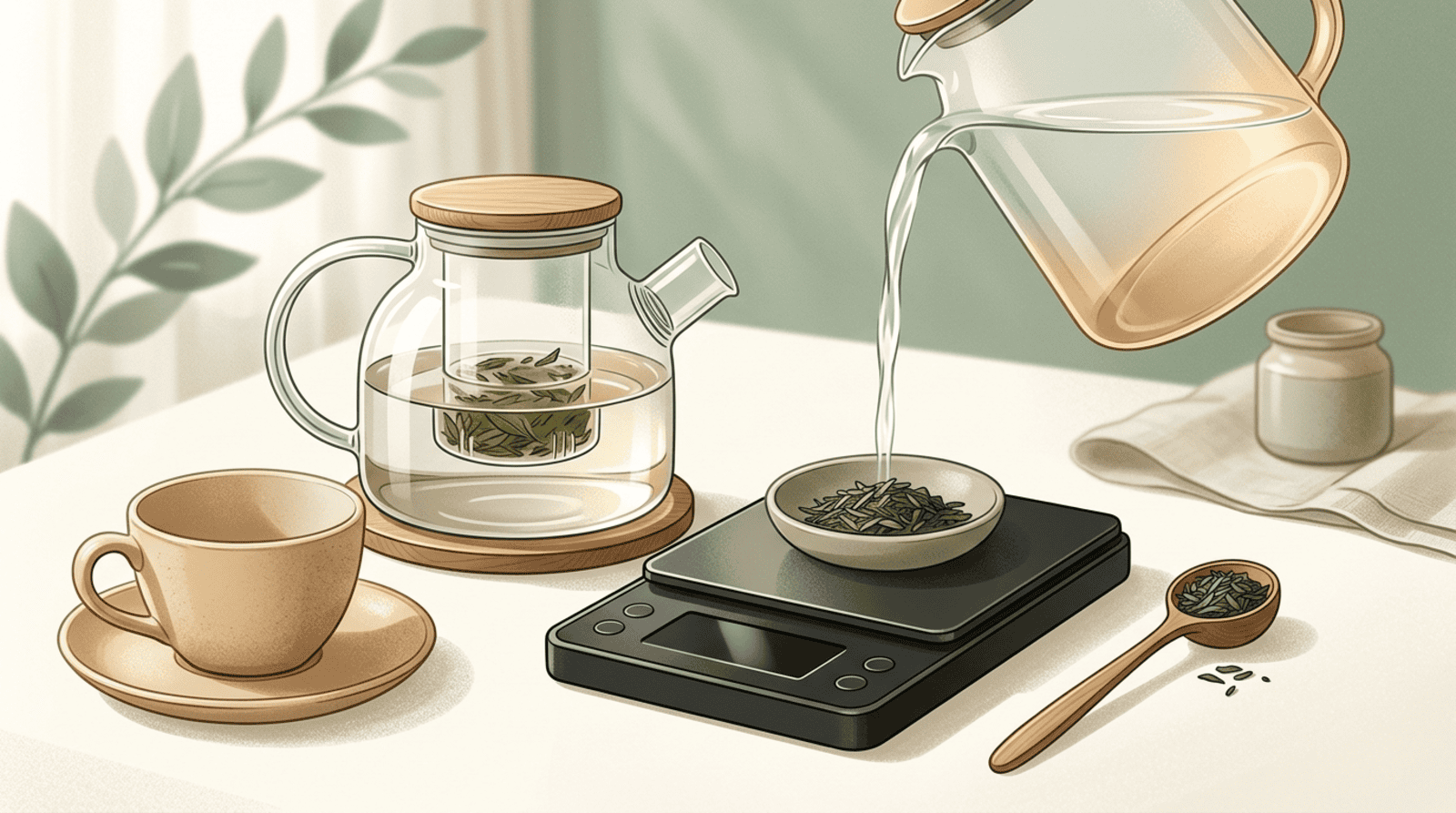
If you want absolute consistency, invest in a simple digital scale that reads to 0.1 grams. Weighing your tea for just a week will train your eyes to recognize what 2 grams looks like across different leaf styles. After that, you can eyeball your scoops with far greater confidence.
Eastern / Gongfu Ratios: High Leaf, Short Time
If you brew using traditional Gongfu style in a gaiwan or small Yixing clay pot, the ratio philosophy flips completely. Instead of steeping a little tea for a long time, Gongfu brewing uses a lot of leaf in very little water for very short bursts of time.
The standard Gongfu ratio is:
5 to 8 grams of tea per 100 to 120 ml (3.5 to 4 oz) of water.
This represents a concentrated ratio between 1:15 and 1:20.
Why use such a high concentration? Because Gongfu steeps last only 10 to 30 seconds. The high leaf density extracts the volatile aromatics and sweet amino acids without giving the slower-extracting bitter tannins time to dominate the cup. As the tightly rolled leaves unfurl across 6, 8, or even 12 subsequent infusions, the flavor profile transforms with every pour.
If you are curious about exploring Gongfu tea, our guide to the Gongfu Tea Ceremony walks through the tools, warming steps, and pouring techniques step by step.
Complete Tea to Water Ratio Chart by Category
To help you dial in any tea in your collection, here is a quick-reference guide combining leaf ratios, water temperature, and initial steeping times:
| Tea Category | Western Ratio (per 8 oz / 240 ml) | Gongfu Ratio (per 100 ml) | Water Temperature | Western Steep Time |
|---|---|---|---|---|
| Green Tea (Sencha, Longjing) | 2.0g (1 level tsp) | 4.0–5.0g | 160°F–175°F (70°C–80°C) | 1–2 minutes |
| Delicate Green (Gyokuro) | 3.0g (1.5 level tsp) | 5.0–6.0g | 140°F–150°F (60°C–65°C) | 1.5–2 minutes |
| Black Tea (Assam, Darjeeling) | 2.0–2.5g (1 level tsp) | 5.0–6.0g | 200°F–212°F (93°C–100°C) | 3–5 minutes |
| Light Oolong (High Mountain) | 2.0g (0.5–0.75 tsp) | 6.0–7.0g | 185°F–195°F (85°C–90°C) | 2–3 minutes |
| Dark / Roasted Oolong | 2.0–2.5g (0.75 tsp) | 7.0–8.0g | 195°F–205°F (90°C–96°C) | 3–4 minutes |
| White Tea (Silver Needle) | 2.5–3.0g (1.5–2 tsp) | 4.5–5.5g | 175°F–185°F (80°C–85°C) | 3–4 minutes |
| Pu-erh (Ripe Shou or Raw Sheng) | 2.5g (1 level tsp) | 7.0–8.0g | 205°F–212°F (96°C–100°C) | 3–5 minutes |
| Herbal Tisanes (Peppermint, Rooibos) | 2.0–3.0g (1–2 tsp) | N/A (Western preferred) | 212°F (100°C) | 5–7 minutes |
Notice that water temperature remains a critical partner to your ratio. Brewing green tea at 212°F (100°C) will cause rapid over-extraction even with a modest ratio. For a deep dive on thermal management, see our guide on why temperature matters.
Ratios for Iced Tea and Cold Brew
Cold extraction behaves differently from hot water brewing. Because cold water cannot extract tannins as aggressively, you can adjust your ratios to produce clean, naturally sweet beverages without astringency.
1. The Cold Brew Ratio
Cold brew tea relies on time (8 to 12 hours in the refrigerator) rather than heat. Because the extraction rate is gentler, you need slightly more leaf to achieve full-bodied flavor:
- Cold brew formula: 10 to 12 grams of tea per 1 liter (34 oz) of cold filtered water.
- Place the tea leaves directly into a pitcher, fill with cold water, seal, and refrigerate overnight. Strain in the morning for a silky, naturally sweet brew.
2. The Flash-Chill (Hot Over Ice) Ratio
If you want iced tea immediately, brewing hot tea and pouring it directly over ice cubes is the fastest method. However, as the hot liquid melts the ice, the drink becomes diluted.
To compensate, double your leaf ratio while keeping water volume the same:
- Flash-chill formula: 4 grams of tea per 8 ounces of hot water.
- Steep for the normal duration, strain, and immediately pour over a tall glass filled with ice cubes. The melting ice will dilute the concentrated liquor down to the perfect drinking strength.
Troubleshooting: How to Adjust Your Ratio
If your cup does not taste quite right, use this troubleshooting framework before changing multiple variables at once:
Problem: The tea is bitter and astringent
- First check: Is your water too hot? (Especially common with green tea).
- Ratio adjustment: If temperature is correct, reduce the leaf amount by 0.5 grams (or 1/4 teaspoon). Do not simply shorten your steep time to 30 seconds, as this leaves the tea tasting one-dimensional. A slightly lower leaf ratio lets the flavors develop smoothly over a full infusion.
Problem: The tea tastes thin, watery, or flat
- First check: Is your mug larger than 8 ounces? A 14-ounce mug brewed with 2 grams of tea will always taste hollow.
- Ratio adjustment: Increase your tea by 0.5 to 1.0 gram. Adding more leaf increases richness, sweetness, and mouthfeel without drawing out excess bitterness.
Problem: The second steep has no flavor
- When resteeping high-quality loose leaf tea, you need enough leaf density in the infuser to retain soluble compounds for later infusions. If your first cup was great but your second cup is lifeless, increase your initial leaf amount by 1 gram. For more tips on getting 3 to 5 delicious cups from one batch of leaves, consult our guide on how to resteep tea.
Perfect Precision with Tea Timer
Mastering the tea to water ratio is the foundation of great tea. Once you measure the right amount of leaf into your vessel, the final step is ensuring your steeping duration matches the exact requirements of your tea variety.
The Tea Timer app takes the guesswork out of timing and temperature. With pre-calibrated timers for dozens of green, black, oolong, white, pu-erh, and herbal teas, Tea Timer gives you the confidence that every gram of carefully measured tea extracts to its full potential. With Live Activities on your iPhone and seamless Apple Watch support, you will never over-steep a cup while distracted again.
Download Tea Timer on the App Store →
Summary
The next time you prepare a cup of tea, remember these simple guidelines:
- Remember the baseline: 2 grams of loose leaf tea for every 8 ounces (240 ml) of water in Western brewing.
- Account for mug size: Scale up to 3 grams for 12-ounce mugs and 4 grams for 16-ounce travel tumblers.
- Beware of teaspoons: Fluffy leaves need more volume; dense rolled pearls need less. Use a gram scale when trying new teas.
- Try Gongfu for complexity: Use 5 to 8 grams per 100 ml for short, layered multi-infusion sessions.
Take a moment to measure your leaves thoughtfully, let Tea Timer keep watch on the clock, and enjoy the rich, nuanced flavors of a perfectly proportioned brew.
Related Articles

Tea Steeping Times: The Complete Chart for Every Type of Tea
How long to steep every tea: exact times and temperatures for green, black, oolong, white, pu-erh, and herbal, plus tea bag, gongfu, and resteep timings.

Why You Need a Tea Timer (Your Phone Alarm Isn't Cutting It)
A phone alarm wakes you up, it does not brew tea. Here is why a dedicated tea timer changes every cup, what to look for in one, and how Tea Timer gets it right.

8 Tea Brewing Mistakes (And How to Fix Them)
From scalding green tea to throwing away perfectly good leaves, these common mistakes are ruining your cup. Here's how to brew better tea starting today.