8 Tea Brewing Mistakes (And How to Fix Them)
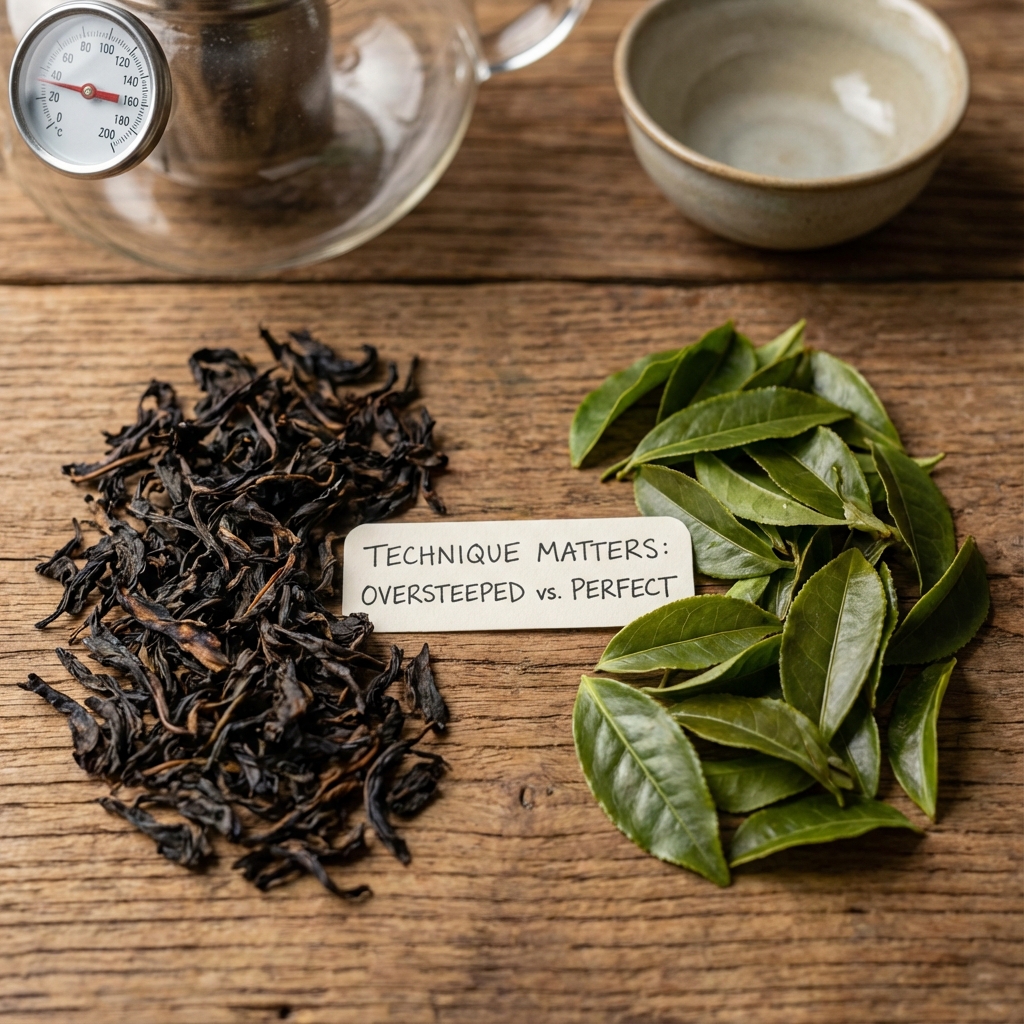
You bought premium loose leaf tea. You boiled water. You waited... something. And then you took a sip and wondered why it tastes nothing like what the tea shop promised.
Sound familiar?
Here's the truth: most people are accidentally sabotaging their own tea. The good news? These mistakes are easy to fix once you know what you're doing wrong.
Let's walk through the 8 most common tea brewing mistakes and their simple solutions.
Mistake #1: Using Boiling Water for All Teas
The Problem
You hear the kettle click off at 212°F (100°C) and immediately pour it over your delicate green tea. Thirty seconds later, you're drinking bitter, astringent disappointment.
Why it happens: Coffee needs boiling water. Many people assume tea does too. It doesn't.
What's actually going wrong: Boiling water destroys the delicate compounds in green and white teas, extracting only the bitter tannins while killing the sweet amino acids (especially L-theanine) that give tea its complexity.
The Fix
Match your water temperature to your tea type:
| Tea Type | Ideal Temperature | What Happens If Wrong |
|---|---|---|
| Green Tea | 160-180°F (70-80°C) | Too hot = grassy, bitter, astringent |
| White Tea | 170-185°F (75-85°C) | Too hot = flat, loses floral notes |
| Oolong Tea | 185-205°F (85-96°C) | Too hot = overly roasted, harsh |
| Black Tea | 200-212°F (93-100°C) | Too cool = weak, underdeveloped |
| Pu-erh Tea | 200-212°F (93-100°C) | Too cool = muddy, lacks depth |
| Herbal Tea | 212°F (100°C) | Generally tolerant of high heat |
Pro tip: If you don't have a temperature-controlled kettle, just wait. After boiling, let the water sit for:
- 1 minute for black tea and pu-erh (200-205°F)
- 3 minutes for oolong (185-195°F)
- 5 minutes for green tea (170-180°F)
- 7 minutes for white tea (160-170°F)
Or better yet, use Steep—it tells you exactly what temperature to use for each tea type, so you never have to guess.
Mistake #2: Steeping for "Until It Looks Dark Enough"
The Problem
You watch the water change color and decide your tea is ready based on... vibes? Intuition? The color looks right?
Why it happens: We're visual creatures. Dark tea looks strong, so it must be done, right?
What's actually going wrong: Tea color is a terrible indicator of brew completion. Some teas (like gyokuro green tea) stay pale even when perfectly brewed. Others (like Kenyan black tea) turn dark almost instantly but need more time to develop complexity.
The Fix
Use a timer. Every single time.
Here are the actual steep times for common teas:
- Green tea: 1-3 minutes (yes, really, that short)
- White tea: 4-5 minutes
- Oolong tea: 3-5 minutes (Western), 30-60 seconds (Gong Fu)
- Black tea: 3-5 minutes
- Pu-erh: 30 seconds - 2 minutes (depends on style)
- Herbal tea: 5-7 minutes
Steeping for "until it looks right" is like baking a cake until "it looks done"—you'll be wrong more often than right.
The Steep advantage: The app has pre-programmed times for 8 premium tea types and lets you create custom timers for your specific teas. Start the timer, walk away, and get notified when it's perfect.
Mistake #3: Throwing Away Leaves After One Steep
The Problem
You steep your $15-per-ounce oolong tea once, then dump the leaves down the sink. You just threw away 70% of what you paid for.
Why it happens: Western tea culture treats tea like coffee—one use and done.
What's actually going wrong: Quality loose leaf tea is designed for multiple infusions. In fact, many teas (especially oolong and pu-erh) are just warming up on the first steep. The second and third infusions are often the best.
The Fix
Re-steep your tea—especially oolong, pu-erh, white, and high-grade green teas.
How many times can you re-steep?
- Oolong: 4-8 steeps
- Pu-erh: 6-10 steeps
- White tea: 3-5 steeps
- Green tea: 2-4 steeps
- Black tea: 2-3 steeps
Key rule: Keep the temperature the same, but increase steeping time with each infusion:
- 1st steep: 3 minutes
- 2nd steep: 4 minutes
- 3rd steep: 5 minutes
- 4th steep: 7 minutes
Want the full guide? Check out our detailed post: How to Re-Steep Tea: Getting 3-5 Cups from the Same Leaves
Steep makes this effortless: For teas that support multiple infusions, the app automatically tracks which steep you're on and adjusts the timer accordingly. Just tap "Start Next Steep" and it handles the progression.
Mistake #4: Using Too Much (or Too Little) Tea
The Problem
You eyeball the amount of tea leaves, and your results are wildly inconsistent. One day it's too weak, the next it's undrinkably strong.
Why it happens: "A spoonful" is not a measurement. Different teas have different densities—a teaspoon of tightly rolled oolong weighs far less than a teaspoon of fluffy white tea.
What's actually going wrong: The leaf-to-water ratio dramatically affects extraction. Too many leaves = over-extraction and bitterness. Too few = weak, watery tea.
The Fix
Use a scale (or at least consistent measurements).
Standard ratios:
- Western brewing: 2-3 grams per 8 oz (240ml) of water
- That's roughly 1 teaspoon for most teas
- Gong Fu brewing: 5-7 grams per 3.5 oz (100ml) of water
- Much more concentrated, but smaller volume
Visual guide if you don't have a scale:
- Ball-shaped oolong: 1.5 teaspoons
- Strip-leaf black tea: 1 teaspoon (heaping)
- Fluffy white tea: 2 teaspoons
- Fine green tea: 1 teaspoon (level)
Consistency matters more than precision: Pick a measurement and stick with it. Once you find your preferred strength, replicate it.
Mistake #5: Ignoring Water Quality
The Problem
You're using tap water that smells faintly of chlorine or has a metallic taste. Then you wonder why your $30 first-flush Darjeeling tastes... off.
Why it happens: We assume water is water. It's not.
What's actually going wrong: Tea is 99% water. If your water has chlorine, heavy minerals, or off-flavors, those become part of your tea. Hard water creates a filmy layer on top. Chlorinated water adds chemical notes. Distilled water makes tea taste flat.
The Fix
Use filtered water with balanced minerals.
Water quality ranking (best to worst for tea):
- Spring water (bottled or fresh)—natural minerals, clean taste
- Filtered tap water (carbon filter)—removes chlorine, retains some minerals
- Tap water (if your city has good water)—check for chlorine smell
- Distilled water—too pure; tea tastes dull and lifeless
- Hard water—creates film, mutes flavors
Quick test: Smell your water before boiling. If it smells like anything other than... nothing... your tea will taste like that.
Easy fix: A simple Brita filter or similar carbon filter removes chlorine and most off-flavors while retaining beneficial minerals.
Mistake #6: Leaving the Tea Bag/Infuser In
The Problem
You start steeping your tea, get distracted by a phone call, and 15 minutes later remember you have a cup of tea. It's now undrinkably bitter and astringent.
Why it happens: Life is distracting. You forget. We've all done it.
What's actually going wrong: Tea doesn't stop extracting when it "looks ready." The leaves continue releasing tannins and bitter compounds the entire time they're in contact with water. What was perfect at 3 minutes is ruined by 10 minutes.
The Fix
Remove the leaves when the timer goes off. Not 30 seconds later. Right when it beeps.
Strategies to remember:
- Set your timer to a sound you can't ignore
- Brew tea only when you can be near the kitchen
- Use Live Activities on iPhone (if you have Steep)—the timer shows on your Lock Screen and Dynamic Island, impossible to miss
- Keep a small dish next to your teapot for the infuser
Already over-steeped your tea? Try these rescue tactics:
- Add hot water to dilute (sacrifices some flavor but reduces bitterness)
- Add a tiny pinch of baking soda (neutralizes tannins, but changes the taste)
- Add honey or sweetener (masks bitterness, doesn't eliminate it)
- Accept defeat and start over (sometimes it's too far gone)
Prevention is easier than fixing: This is exactly why Steep sends notifications to your Apple Watch and iPhone. You can be anywhere in the house and know the instant your tea is ready.
Mistake #7: Storing Tea Incorrectly (and Wondering Why It Went Stale)
The Problem
You bought a beautiful tin of loose leaf tea six months ago. It's been sitting on your counter next to the stove ever since. Now it tastes like cardboard.
Why it happens: Tea is a dried plant. Like all dried foods, it degrades when exposed to enemies: light, heat, moisture, and air.
What's actually going wrong:
- Light breaks down chlorophyll and aromatic compounds (especially bad for green tea)
- Heat accelerates oxidation (that "stale" taste)
- Moisture causes mold or fermentation (unless you want fermentation, like with pu-erh)
- Air oxidizes the leaves, making them taste flat
The Fix
Store tea properly and it'll stay fresh for months (or even years, for pu-erh).
The perfect tea storage setup:
- Airtight container (tin, ceramic, or vacuum-sealed bag)
- Dark location (inside a cabinet, not on the counter)
- Cool temperature (room temp is fine, just not near the stove)
- Away from strong smells (tea absorbs odors—don't store it next to coffee or spices)
Shelf life by tea type (when stored correctly):
- Green tea: 6-12 months
- White tea: 1-2 years (improves with age if stored well)
- Oolong tea: 1-2 years
- Black tea: 1-2 years
- Pu-erh tea: Decades (literally gets better with age)
- Herbal tea: 6-12 months
Warning signs your tea has gone bad:
- Smells musty, stale, or like nothing at all
- Tastes flat or papery
- Leaves look faded or discolored
- Visible moisture or mold (discard immediately)
Mistake #8: Expecting Every Tea to Taste Amazing Immediately
The Problem
You try a new tea, brew it once according to the package directions, decide you don't like it, and never touch it again.
Why it happens: We expect instant perfection. If the first cup isn't amazing, we assume the tea is bad or "not for us."
What's actually going wrong: Tea is more like cooking than following a recipe. Package directions are starting points, not gospel. Your water, your palate, your teaware—they all matter. Some teas need 2-3 attempts before you dial in the perfect brew.
The Fix
Experiment. Adjust. Iterate.
If your tea tastes wrong, troubleshoot:
| Problem | Diagnosis | Solution |
|---|---|---|
| Bitter/Astringent | Water too hot OR steeped too long | Lower temp by 10°F, reduce time by 30 sec |
| Weak/Watery | Not enough leaves OR not steeped long enough | Add more leaves OR increase time by 30 sec |
| Grassy/Vegetal | Water too hot (green tea) | Lower temp to 170-175°F |
| Flat/Dull | Leaves are stale OR water is too cool | Check freshness, increase temp by 10°F |
| Sour/Fermented | Leaves are old or improperly stored | Try fresh batch with proper storage |
The 3-brew rule: Give every new tea at least three attempts, adjusting variables each time:
- 1st brew: Follow package directions
- 2nd brew: Adjust ONE variable (temp OR time OR leaf amount)
- 3rd brew: Fine-tune based on what worked
Most "bad" teas are just mis-brewed teas.
Steep helps you experiment systematically: Create custom tea profiles with your adjusted times and temperatures. Save what works, discard what doesn't.
Bonus Mistake: Not Enjoying the Process
Here's the mistake nobody talks about: rushing through tea.
Tea isn't instant coffee. It's not a caffeine delivery system (though it does that too). The brewing process—the ritual of heating water, measuring leaves, waiting for the timer, pouring the cup—is part of the experience.
If you're stressed about "wasting time" while your tea steeps, you're missing the point.
The fix: Build tea brewing into a moment of pause. Those 3 minutes of steeping aren't wasted—they're a forced break in your day. Use them:
- Close your eyes and breathe
- Step outside for fresh air
- Stretch
- Do nothing at all
Tea has been a meditation practice for over a thousand years. The timer isn't a burden—it's a gift of structured stillness.
Your Perfect Cup is Closer Than You Think
Here's what's amazing: fixing these mistakes costs nothing. You don't need expensive equipment. You don't need to become a tea sommelier. You just need to:
✅ Match water temperature to tea type ✅ Use a timer ✅ Re-steep your leaves ✅ Measure consistently ✅ Use decent water ✅ Remove leaves when done ✅ Store tea properly ✅ Give new teas a fair shot
Do those eight things, and your tea will transform overnight.
And if you want to make it even easier? That's exactly why we built Steep. It handles the temperatures, the timings, the re-steep progressions, and the notifications—so you can focus on the only part that matters: enjoying your tea.
Ready to stop guessing and start brewing perfectly? Download Steep on the App Store →
Perfect tea is just a timer away.
Related Articles

White Tea Brewing Guide: The Art of Delicate Perfection
Discover how to brew the most delicate tea with precision. Master white tea temperatures, steeping times, and techniques for an exceptional cup.

Herbal Tea Brewing Guide: Tisanes Done Right
Herbal teas aren't technically tea—but they deserve just as much care. Learn the ideal temperatures, steep times, and techniques for chamomile, peppermint, rooibos, and more.

The Perfect Green Tea: A Complete Brewing Guide
Master the art of brewing green tea with precise temperatures, timing, and techniques for the perfect cup every time.