How to Brew Loose Leaf Tea Without a Strainer or Infuser
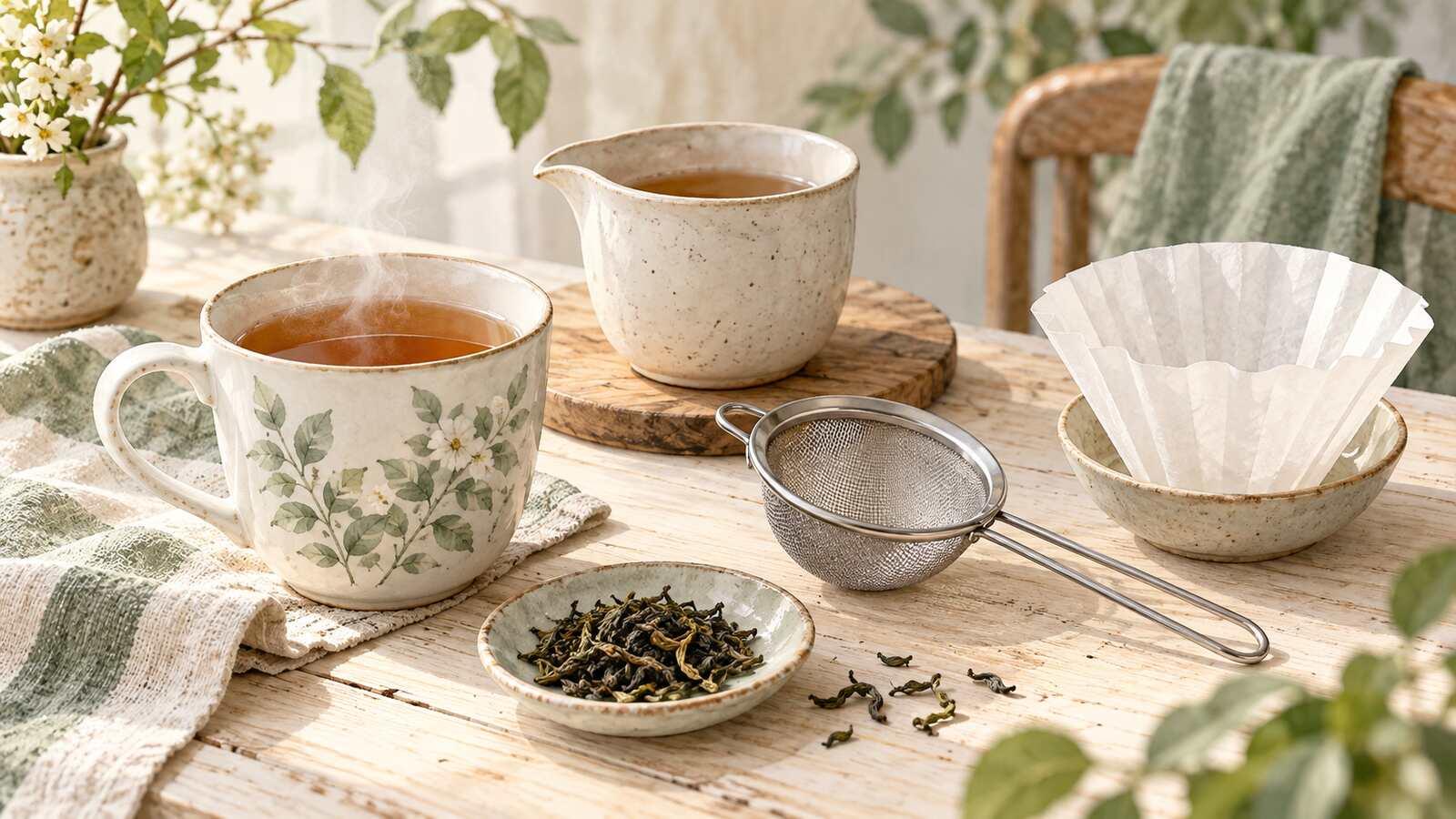
You have loose tea, hot water and a mug, but no tea infuser. You can still make a good cup. The essential job of an infuser is simple: give the leaves room in the water and separate the finished tea from them when the steep ends. A second cup, a clean kitchen sieve, a coffee filter or a French press can do that job. Choose by leaf size and available tools.
This guide is a method selector, not another list of things to buy. Senbird Tea describes kitchen sieves and coffee filters, while Full Leaf Tea Company describes filters, French presses and brewing directly in a cup. The decision table below makes the practical trade-offs explicit: how well each method catches small particles, whether leaves keep extracting after you pour, and what to clean. We have not run a personal head-to-head tasting of these tools.
First choose by leaf size and equipment
Look at the dry tea. Large whole leaves or rolled balls are easier to hold back when pouring between cups. Fine broken black tea, rooibos or a powdery blend can escape a spoon or a coarse sieve. A paper coffee filter catches more of the fine particles, but drains slowly and can absorb some liquid. A French press works if you own one and its mesh is suitable for your leaf. No tool gives a magically perfect cup; the table helps you choose the least fussy workable option.
| What you have | Best match | How to end the steep | Main limitation |
|---|---|---|---|
| Two heat-safe cups and a spoon | Large whole leaves | Pour gently into the second cup, holding back floating leaves | Fine fragments pass through |
| Fine kitchen sieve | Most loose-leaf teas | Brew in one vessel, then pour through sieve into cup | A coarse mesh may pass dust |
| Food-use paper coffee filter | Fine or broken leaves | Pour finished tea slowly through filter | Slow flow; support filter securely |
| Clean French press | Medium or large leaves | Press gently at the chosen time and pour all tea out | Tea left in the press keeps steeping |
| Only a mug | Large leaves you do not mind seeing | Sip above settled leaves or decant as soon as possible | Extraction continues in the cup |
The leaf-size advice is a simple match between particle size and opening size, not a claim that a particular tea type always has one particle size. Check your actual blend. If you have a food-use filter, use that rather than improvising with random printed paper, scented tissue or materials whose suitability for hot drinks you do not know. This page does not ask you to make a foil pouch or cut a container that was not designed for brewing.
The two-cup method, with a spoon or sieve
For whole leaves, put the tea in one heat-safe cup or small pot. Add the water recommended for that tea, cover if you normally would, and start a timer. At the intended end, hold the largest leaves back with a spoon and pour slowly into a second cup. Stop pouring before the last leaf-heavy sip. That final spoonful can stay behind. A few tiny fragments in the cup are not a failed brew; if they bother you, choose a sieve next time.
With a fine kitchen sieve, the method is easier. Set the sieve securely over the drinking cup. Brew leaves freely in a separate heat-safe vessel, then pour the entire brewed tea through the sieve at the end of the timed steep. Use a sieve whose mesh actually catches the particles in your tea. A coarse colander will not catch finely broken leaves. Keep your hands clear of the hot stream and avoid an unstable sieve perched on a narrow rim.
Both versions share an important benefit: after decanting, the finished cup is no longer in contact with most leaves. That makes the brew time a real stop point. The tea steeping times chart can supply a starting range for your tea, but packaging instructions take priority when a specific blend gives them. Do not leave the first cup full of leaves while you drink the second and call that a controlled second steep; start a separate timed infusion if you want another cup.
Coffee filter: useful for small particles
A paper filter sold for food or coffee use is a practical choice for finer tea. Put it in a stable filter holder or sieve above a cup. You can rinse it with hot water first if paper taste is a concern, then discard the rinse water. Brew the loose tea in a separate vessel for its normal time. When the timer ends, pour slowly through the filter. The tea should finish steeping in the first vessel, not spend another unpredictable interval sitting in a filter full of hot water.
A coffee filter and a makeshift tea bag are not the same task. Here the leaves have space to infuse in the first vessel and the filter only separates tea at the end. You do not need to staple, tie, cut or heat an unknown material to create a pouch.
French press: press, then empty it
A clean French press can hold loose leaves and water with plenty of room. Check that it has no lingering coffee smell if you do not want that flavor in your tea. Add the tea and water at the blend's chosen temperature, leave the plunger up, and time the steep. At the end, lower the plunger gently, then pour all the tea into cups or another vessel. Pushing the mesh down does not stop extraction completely if tea stays in contact with wet leaves at the bottom.
Match the mesh to the leaf. A press may work well for larger black tea, oolong or herbal pieces and let fine particles through. If your blend is very fine, use a paper filter or fine sieve instead. Do not press hard to force water through tightly packed leaves; the plunger is a separator, not a way to wring them dry. Full Leaf Tea Company describes the press method as a reusable alternative to a dedicated infuser. Our added timing instruction follows from the same separation rule as the two-cup method.
If you have only a mug
Brewing leaves directly in a mug, sometimes called a grandpa-style method, is possible. Use a tea with relatively large leaves, add water appropriate to that tea, and let the leaves settle. Sip from the top without stirring up the bottom. Full Leaf Tea Company describes this approach for larger, repeatedly infused leaves. It is less convenient for fine particles and not a precise timed infusion, because leaves remain in the drink as you sip.
If you need a controlled cup, find a second vessel and decant when the timer ends. That is especially useful for a tea that becomes unpleasant when left with hot water. If a few leaves land in the second cup, you can leave the last sip behind; there is no need to keep straining and reheating the same tea. Do not pour boiling water into a vessel you are unsure is heat-safe.
For any method, begin with the leaf amount, water temperature and steep range on the package or in a guide for that tea. Those variables belong to the tea, not to the improvised filter. A delicate green tea, a robust black tea and a herbal infusion do not become interchangeable merely because all three pass through the same sieve. Our black tea brewing guide and tea steeping times chart provide starting points when the package is silent.
A short cleanup and troubleshooting check
- Leaves in the drinking cup? Choose a finer sieve or food-use filter next time, or stop decanting before the leaf-heavy bottom of the first cup.
- Tea tastes bitter or rough? Check the steep time and whether you poured all the liquid away from the leaves at the end. More filtering after over-steeping cannot undo extraction.
- Tea tastes weak? Check the leaf-to-water amount before lengthening the steep. A large, fluffy leaf and a small broken leaf do not weigh the same by teaspoon.
- Filter drains too slowly? Use a larger supported filter or a finer sieve that still flows. Pour in stages rather than balancing a full, wet filter on the cup.
- Press tea tastes of coffee? Clean the press well or choose two cups and a sieve. A tool that carries another drink's aroma changes this one.
The cleanup is straightforward: discard or compost spent leaves according to what your local system accepts, rinse the sieve or press, and let it dry. Do not put wet leaves into a storage tin. Next time you have a proper infuser, the same timing and water choices still apply. The accessories guide explains what a basket infuser adds if you decide to buy one later; you do not need it to make today's cup.
Can I use a coffee filter as an infuser inside the mug? A food-use filter can hold leaves, but the method above is easier to control: brew freely, then filter at the planned end. If you use a filter as a bag, it needs a stable support and enough room for leaves.
Can I just leave the leaves in the mug? Yes for a style you enjoy with larger leaves, but the taste keeps changing while the leaves remain in hot water. For a repeatable steep, decant into another cup at the chosen time.
What if I have no second cup? A clean French press or suitable filter can separate the tea. With only one mug and no separator, choose a large-leaf direct-cup tea and accept that it is less controlled. There is no need to invent a filter from unsuitable materials.
Keep the stop time, whatever tool you use
The tool changes how you separate leaves; it does not change when the tea has reached your chosen steep time. A timer makes that boundary easier to keep while you find a second cup or warm milk for another drink. Tea Timer on iPhone and Apple Watch can time the tea you actually own and alert you when it is time to pour. It cannot make a coarse sieve catch dust, so choose the separation method first.
If this is your first loose-leaf cup, the loose leaf versus tea bags guide explains the format trade-offs. Get Tea Timer on the App Store if you want a timer for the method you choose. Today, two cups and a careful pour may be all you need.
Related Articles

The Best Tea Timer App in 2026 (iPhone & Apple Watch)
Looking for the best tea timer app? We compare Tea Timer against your phone alarm, smart speakers, and kitchen timers on presets, Apple Watch, and multi-steep.

Why You Need a Tea Timer (Your Phone Alarm Isn't Cutting It)
A phone alarm wakes you up, it does not brew tea. Here is why a dedicated tea timer changes every cup, what to look for in one, and how Tea Timer gets it right.

The Tea to Water Ratio Guide: How Much Tea Per Cup Every Time
Master the perfect tea to water ratio with simple formulas for mugs, pots, and Gongfu brewing. Learn exact gram and teaspoon measurements for every tea type.