Da Hong Pao
China · Wuyi Mountains, Fujian
Quick Brewing Summary
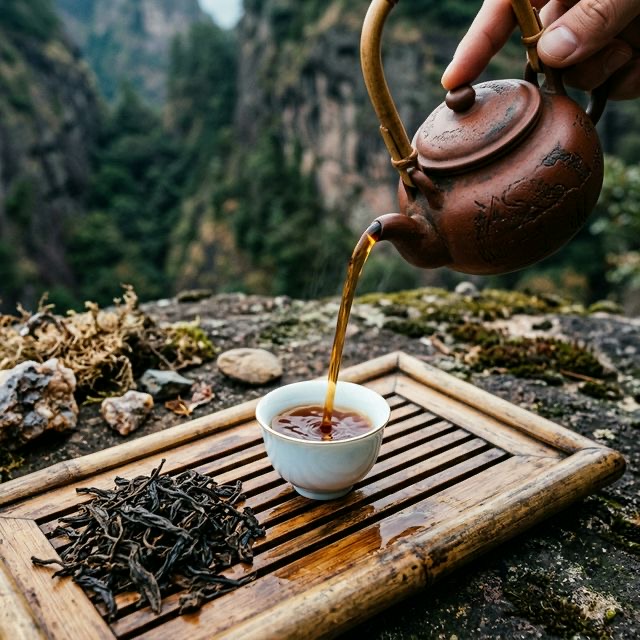
Water Temperature
95°C
203°F
Steep Time
1:00
min:sec
Water Amount
120 ml
4 oz
Leaf Amount
7 g
2 tsp
The Big Red Robe
Da Hong Pao, or "Big Red Robe," is the most famous of the Wuyi rock teas — a category of oolongs known in Chinese as yancha, meaning "cliff tea." Grown on the steep, rocky slopes of the Wuyi Mountains in northern Fujian Province, Da Hong Pao has achieved near-mythical status in the tea world. The original mother bushes, clinging to a cliff face in the Jiulong Ke ravine, are among the most valuable plants on Earth. While those ancient trees are no longer commercially harvested, their cuttings and descendants continue to produce tea of extraordinary depth and complexity.
Origin and Legend
The legends of Da Hong Pao are as dramatic as its flavor. The most popular tale recounts a Ming Dynasty scholar who fell ill on his way to imperial examinations. Monks from the nearby Tianxin Temple brewed him tea from the cliff-side bushes, and his recovery was so remarkable that after passing his exams, he returned to drape his red scholar's robe over the bushes in gratitude — hence the name "Big Red Robe." Whether or not the story is true, it speaks to the reverence the Chinese have held for this tea for over four centuries.
Terroir and the Rock Bone
What sets Da Hong Pao apart from other oolongs is the concept of "yan yun," often translated as "rock rhyme" or "rock bone." The Wuyi Mountains' unique geology — a UNESCO World Heritage landscape of sandstone and volcanic rock laced with mineral-rich springs — imparts a distinctive mineral quality to the tea. The narrow gorges and mist-covered cliffs create a microclimate of filtered sunlight and constant humidity that concentrates flavor compounds in the leaves. Tea drinkers describe this quality as a persistent, almost stony sweetness that lingers in the throat long after the last sip.
Production
Da Hong Pao undergoes a heavier oxidation than many oolongs, typically ranging from 40 to 70 percent, followed by a crucial charcoal roasting phase. Skilled roasters carefully apply heat over multiple sessions spanning weeks or even months, gradually building layers of complexity without burning away the tea's inherent character. This roasting transforms the leaf's raw vegetal energy into something richer — dried stone fruit, dark chocolate, toasted walnut, and a deep caramel sweetness that sits beneath the mineral framework.
Flavor Profile
The first sip of well-made Da Hong Pao is unmistakable. A wave of roasted warmth gives way to surprising sweetness — think baked peach or roasted plum — underscored by that signature mineral backbone. The mouthfeel is thick and coating, almost oily, and the aftertaste can linger for minutes. Across multiple gongfu infusions, the roasted notes gradually peel back to reveal the tea's greener, more floral core. It is this evolution that makes Da Hong Pao endlessly fascinating.
Caffeine and Enjoyment
Da Hong Pao provides a moderate caffeine level, typically 30 to 50 milligrams per cup, balanced by L-theanine for smooth, focused energy. Traditionally enjoyed in the gongfu style with small vessels and multiple short steeps, it is a tea that rewards patience and attention. In Chinese tea culture, sharing Da Hong Pao is an act of hospitality and respect — a tea you bring out for honored guests and quiet evenings of conversation.
Health Benefits
- Contains polyphenols that support heart health
- Rich in minerals from the unique Wuyi rock terroir
- May improve mental alertness and focus
- Supports digestive health, traditionally enjoyed after heavy meals
Brew this tea with Steep
Get precise brewing timers, temperature guides, and multi-steep support for Da Hong Pao and dozens more teas.
App Store