Rooibos
South Africa · Cederberg
Quick Brewing Summary
Water Temperature
100°C
212°F
Steep Time
6:00
min:sec
Water Amount
200 ml
7 oz
Leaf Amount
3 g
1.5 tsp
What Is Rooibos?
Rooibos (pronounced ROY-boss) is an herbal tea made from the needle-like leaves of the Aspalathus linearis plant, a leguminous shrub that grows exclusively in the Cederberg region of South Africa's Western Cape. Often marketed as "red bush tea" in English-speaking countries, rooibos has a naturally sweet, smooth character that sets it apart from every other herbal infusion. It contains no caffeine, virtually no tannins, and a unique set of antioxidants found in no other plant on Earth. These qualities have propelled rooibos from a local South African tradition to one of the most popular caffeine-free teas worldwide.
Origin and History
The indigenous Khoisan people of the Cederberg Mountains have been harvesting and brewing wild rooibos for centuries, long before European settlers arrived. The plant was first documented by Western botanists in 1772, but it remained a regional curiosity until the early 20th century, when a Russian-born South African merchant named Benjamin Ginsberg recognized its commercial potential and began marketing it as a tea alternative.
Rooibos cultivation proved challenging. The plant grows only in the sandy, acidic soil of the Cederberg at elevations between 450 and 900 meters, and early attempts to cultivate it outside this narrow range failed entirely. Even within its native habitat, rooibos seeds are notoriously difficult to germinate. These limitations mean that all rooibos tea in the world still comes from a single small region of South Africa, making it one of the most geographically exclusive beverages in existence.
Production
After harvest, rooibos leaves and stems are bruised, heaped into mounds, and left to oxidize in the sun for 8 to 24 hours. This oxidation process turns the green plant material into the characteristic deep red-brown color and develops the tea's sweet, honeyed flavor. The oxidized leaves are then spread out to dry in the African sun before being sorted, graded, and packed. Unoxidized "green rooibos" is also available — it has a lighter, more herbaceous flavor but is more expensive due to the extra care required to prevent oxidation.
Flavor Profile
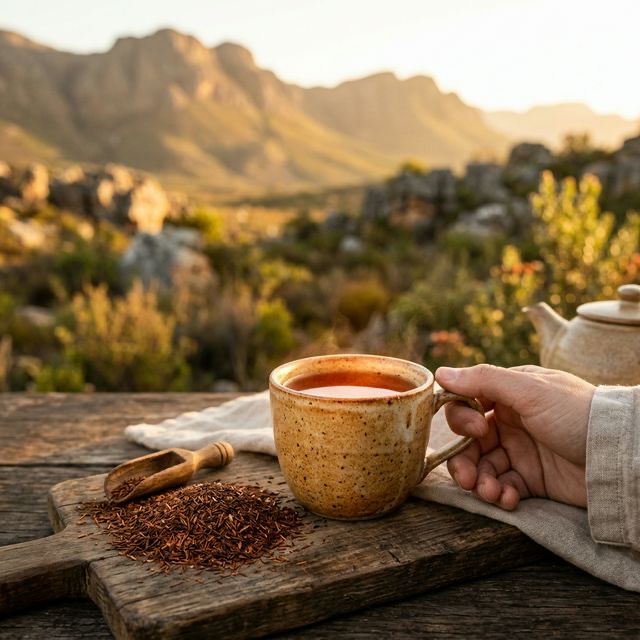
Rooibos brews into a warm, amber-red cup with a naturally sweet flavor that requires no added sugar. The dominant notes are honey, vanilla, and a toasty nuttiness reminiscent of almonds or hazelnuts. There is a subtle woody undertone and an almost creamy mouthfeel, with none of the astringency or bitterness associated with caffeinated teas. The low tannin content means that rooibos cannot be over-steeped in the way that black or green tea can — even a forgotten cup left to brew for twenty minutes remains smooth and drinkable.
Caffeine Content
Rooibos is completely caffeine-free by nature — not decaffeinated through processing, but inherently free of the compound. This makes it a genuine anytime tea, suitable for pregnant women, children, and anyone who needs to avoid stimulants. Its gentle, naturally sweet profile is often recommended as an evening or bedtime drink.
How to Enjoy Rooibos
In South Africa, rooibos is commonly served with milk and sugar, much like British-style black tea — and the naturally sweet, low-tannin profile makes it one of the few herbal teas that genuinely works well with milk. Equally delicious on its own, hot or iced, rooibos is incredibly versatile. It serves as an excellent base for chai-style spiced blends, where cinnamon, ginger, and cardamom complement its inherent sweetness. Try rooibos iced with a slice of orange for a refreshing summer drink, or use strongly brewed rooibos as a cooking ingredient in smoothies, oatmeal, or baked goods. Its forgiving nature and crowd-pleasing flavor make it one of the best herbal teas to offer guests who may not typically drink tea.
Health Benefits
- Rich in unique antioxidants including aspalathin and nothofagin
- Naturally caffeine-free and low in tannins
- May support bone health due to mineral content (calcium, manganese)
- Traditionally used to soothe allergies and skin conditions in South Africa
Brew this tea with Steep
Get precise brewing timers, temperature guides, and multi-steep support for Rooibos and dozens more teas.
App Store