Shou Puerh
China · Yunnan
Quick Brewing Summary
Water Temperature
100°C
212°F
Steep Time
0:30
min:sec
Water Amount
150 ml
5 oz
Leaf Amount
7 g
3 tsp
What Is Shou Puerh?
Shou puerh (also spelled shu pu-erh) is a post-fermented tea produced exclusively in Yunnan Province, China. Unlike most teas, which are consumed relatively fresh, puerh undergoes microbial fermentation that fundamentally transforms the leaf, producing deep, earthy flavors found nowhere else in the tea world. Shou puerh specifically refers to the "ripe" or "cooked" style, created through an accelerated fermentation technique developed in the 1970s to simulate the flavors of naturally aged sheng (raw) puerh without requiring decades of storage.
Origin and History
All authentic puerh tea originates from the large-leaf Camellia sinensis var. assamica cultivar native to Yunnan's ancient tea forests. Puerh has been traded along the Tea Horse Road for centuries, compressed into cakes and bricks for long-distance transport to Tibet, Mongolia, and Southeast Asia. Over these extended journeys, the tea naturally fermented, and consumers developed a taste for the resulting deep, mellow flavors.
By the mid-20th century, demand for aged puerh far outstripped supply. In 1973, the Kunming Tea Factory developed a controlled fermentation process called "wo dui" (wet piling), in which maocha (sun-dried raw tea) is moistened, heaped into large piles, covered with thermal blankets, and allowed to ferment under controlled temperature and humidity for 45 to 60 days. Beneficial bacteria and fungi break down the leaf's cell structure, darkening the tea from green to a deep reddish-brown and producing the characteristic earthy sweetness. This innovation made aged-tasting puerh accessible to a much wider market.
Flavor Profile
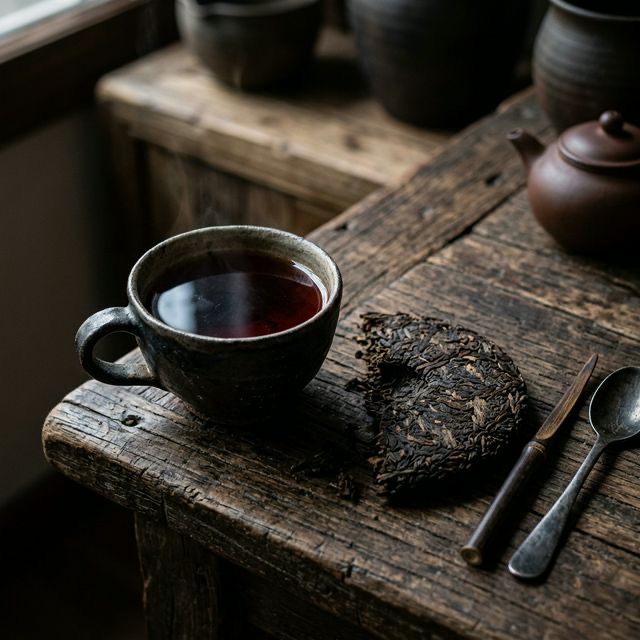
A well-crafted shou puerh brews into a dark, inky liquor that can appear almost black in a cup. The flavor is remarkably smooth and free of astringency. Dominant notes include damp earth, forest floor, dark chocolate, and aged wood, with supporting hints of dried dates, mushroom, and a subtle sweetness reminiscent of molasses. The mouthfeel is thick and velvety, almost creamy. Higher-quality shou puerh — particularly those made from old-growth trees — exhibit greater complexity and a clean, lingering finish, while lower-grade versions can taste muddy or overly one-dimensional.
Aging and Storage
While shou puerh is designed to be drinkable immediately, it continues to evolve with age. Freshly produced shou may carry a slight "wo dui" fermentation taste (sometimes described as fishy or musty), which typically dissipates after one to three years of storage. Beyond that, aging refines the tea further, smoothing the body and deepening the sweetness. Shou puerh does not require the decades of patience that sheng puerh demands, but a well-stored cake with five to ten years of age can be noticeably more refined than a fresh one. Store puerh in a clean, dry environment with moderate airflow — avoid sealed plastic, which traps moisture and can cause mold.
Caffeine Content
Shou puerh contains a high level of caffeine, typically 30 to 70 milligrams per cup depending on the brewing method. Gongfu-style brewing with short steeps tends to deliver a higher concentration per small cup, while Western-style brewing dilutes the caffeine across a larger volume. The stimulating effect is tempered by the tea's deeply grounding and warming quality, which many drinkers describe as calming despite the caffeine.
How to Enjoy Shou Puerh
Shou puerh is traditionally enjoyed without any additions, served in small cups after gongfu brewing to appreciate the evolving infusions. It is especially popular as an after-meal tea in southern China and Hong Kong, where it is valued for aiding digestion. Its smooth, low-astringency profile also makes it an excellent evening tea for those who tolerate caffeine well. Pair it with rich, savory foods, dark chocolate, or nuts. For a meditative experience, brew an entire session from a single cake, watching the flavor shift across ten or more steeps.
Health Benefits
- May support healthy digestion and gut microbiome
- Contains statins and antioxidants from fermentation
- Traditionally used to aid fat metabolism after meals
- Provides sustained energy from high caffeine content
Brew this tea with Steep
Get precise brewing timers, temperature guides, and multi-steep support for Shou Puerh and dozens more teas.
App Store