Chrysanthemum Tea: A Measured First Cup and Timing Guide
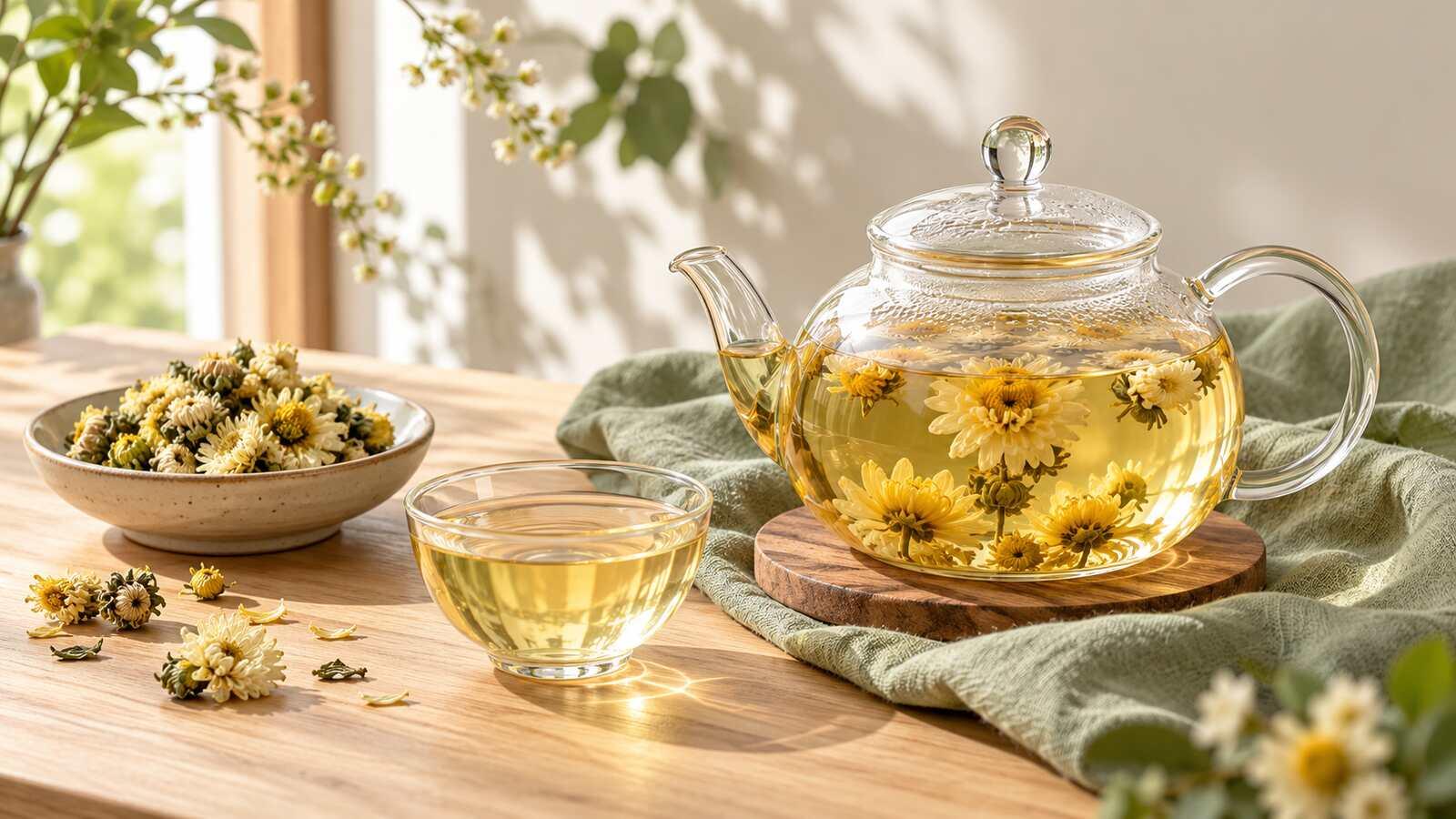
A bag marked chrysanthemum tea can contain nothing but dried flowers, or flowers mixed with green or black tea leaves. Before you heat water, read the full ingredient list. This guide starts with a plain flower infusion, then shows how to adjust one variable at a time instead of treating a spoonful and an arbitrary timer as a fixed recipe.
For a first cup, use 3 g of food-grade dried chrysanthemum flowers in 225 ml of water, brought to a boil. Start tasting after 2 minutes and extend in short steps if your particular flowers taste too light. That ratio and short starting time come from Té Company's chrysanthemum recipe for its product. It is a useful measured starting point, not a rule for every harvest or every packet. If your seller provides directions for the flowers you bought, follow those first.
What is actually in the packet?
Chrysanthemum flower tea is an infusion of dried edible flowers. It is not automatically a tea-leaf product. The front label may say “chrysanthemum tea” even when the ingredient list includes green tea, black tea, or another herb. A pure flower product is described as caffeine-free by Té Company; a blend with tea leaves has tea-leaf caffeine. If the list is incomplete, ask the seller rather than guessing from the name.
Buy flowers packaged for drinking or cooking. Ornamental flowers may be a different variety or treated in ways that make them unsuitable for the kitchen. A flower from a florist, roadside planting, or garden is not a substitute for a labeled food ingredient. This guide is about brewing a purchased product, not plant identification or foraging.
If you are allergic to ragweed, Memorial Sloan Kettering advises avoiding chrysanthemum. It also advises people taking immunosuppressive medicines to avoid this botanical; ask your care team about your own medication before drinking it.
Look at the flower form, too. Whole dried heads, small buds, and loose petals fill a spoon differently. A heaped teaspoon of fluffy heads can weigh much less than the same spoon packed with broken petals. This is why a gram-based recipe is easier to repeat than “a handful.” A scale is helpful, but you can still make a good cup without one if you record the same spoon and fill level each time.
Brew one measured hot cup
Use a heat-safe 250–300 ml mug or pot, a strainer, 3 g dried flowers, and 225 ml fresh water. A small kitchen scale gives the cleanest starting comparison. If you have no scale, use the packet's own spoon guidance and write down whether the spoon was level or heaped; do not convert our 3 g to a universal tablespoon count.
- Check the ingredient list. Use these directions for plain chrysanthemum flowers. If the packet includes green or black tea leaves, use its blend directions or the base tea's temperature instead.
- Weigh flowers and measure water. Put 3 g of flowers in the strainer or pot and measure 225 ml water. If your flowers are very large, make sure the vessel gives them room to open.
- Pour and start the timer. Pour freshly boiled water over the flowers and start timing as the pour begins. Té Company's recipe uses boiling water and a short 1–2 minute steep, with a longer steep to taste. Set your first check at 2 minutes.
- Strain and taste plain. Remove the flowers completely, then taste before adding honey or lemon. The first plain sip tells you whether the flowers, time, and water made the cup you wanted.
- Write down one change. If it was weak, lengthen the next cup by 30–60 seconds while keeping the dose and water the same. If it was too strong, shorten the time or use fewer flowers, changing only one thing at once.
There is no need to chase a precise shade of yellow. Color and aroma can help you compare your own batches, but neither gives a measured caffeine or strength reading. A light-looking cup may still be pleasant, and a darker one may reflect a different flower or longer contact time. Your taste and repeatable measurements are more useful than a color rule.
Cup-strength worksheet
Use this table for your first three attempts. The example rows are our own kitchen starting points, calculated around the producer's 3 g/225 ml ratio; they are not laboratory-tested optimal doses. Keep the flower mass and water fixed while changing time. Once you find your preferred time, you can test a smaller or larger flower dose.
| Cup | Flowers | Water | Water temperature | Strain at | Taste note | Next single change |
|---|---|---|---|---|---|---|
| First baseline | 3 g | 225 ml | Freshly boiled | 2 min | Write your own note | If faint, add 30–60 sec next time |
| Second comparison | 3 g | 225 ml | Same as first | 2½–3 min | Compare with first | Keep time or move it once more |
| Third confirmation | 3 g | 225 ml | Same as first | Your preferred time | Is it repeatable? | Adjust flowers only if needed |
A small timing change only means something when the other variables stay the same. Changing flower amount, mug size, water temperature, sweetener, and time together produces a different drink but tells you little about why. If a first steep is pleasant, you can add fresh water to the used flowers for another infusion. Té Company notes that a refill will be lighter, so treat it as a separate cup rather than expecting the original ratio to behave identically.
If you prefer a 450 ml pot, doubling the baseline gives 6 g flowers and 450 ml water. Keep the first tasting point at 2 minutes, then adjust to your taste. This is simple ratio arithmetic, not an additional producer recommendation. For a 300 ml mug, a proportional starting amount is 4 g. Scaling is helpful only if your flowers and water volumes are measured consistently.
What if you measure by spoon?
Use the same spoon every time and record “level” or “heaped,” because whole buds and loose petals have different shapes and densities. Do not promise that two tablespoons always equal 3 g. If a packet suggests a spoon measure, try its own directions, taste, and then keep the spoon method consistent for the next cup. A scale matters most when you want to compare two products or reproduce a cup weeks later.
You can also save a photo of the dry measure beside your notes. This does not turn volume into mass, but it captures whether you loosely filled or compressed the flowers. The goal is a better second attempt, not laboratory precision in a kitchen mug. Our tea steeping times chart can help you keep other tea types separate from this flower-specific starting point.
Make a cooled or iced version
Brew the measured hot cup and strain it first. For a chilled cup with no melting-ice calculation, let it cool, refrigerate it in a covered container, and serve cold. If you pour 225 ml hot infusion directly over a glass full of ice, melted ice adds water and the result will be lighter. To keep a roughly similar final strength, make a smaller concentrate: as an authored example, use 3 g flowers in 150 ml hot water, strain after your chosen time, then add about 75 ml water from melting ice or cold water to reach roughly 225 ml total. Ice cubes do not melt to a perfectly predictable amount, so taste and adjust.
Add honey or rock sugar while the liquid is warm if you want it dissolved; add lemon only after tasting plain. These are serving options, not required ingredients. A squeeze of lemon can change the taste and sometimes the appearance of a floral drink. If you want a no-heat method, Té Company also describes refrigerating flowers in cold water overnight; follow its packet-specific recipe and keep the container cold, then strain before serving. Do not leave a wet flower mixture at room temperature all day.
For a wider look at dilution over ice, see our iced tea guide. Chrysanthemum does not have to taste like green tea, and an iced flower infusion does not need green tea's water temperature.
If the packet contains tea leaves
A chrysanthemum-green tea blend or chrysanthemum-black tea blend is not the same ingredient as plain flowers. The tea leaves contribute caffeine, and their own brewing directions matter. Start with the blend maker's instructions. If those are missing, identify the base tea and use an appropriate first-cup range from our green tea brewing guide or black tea guide, then adjust for the actual product. A boiling-water flower recipe is not a blanket instruction for a green tea blend.
This ingredient check also prevents a common evening mistake. “Floral” and “herbal” on the front of a package do not by themselves establish that the entire mix is caffeine-free. The detailed label is the useful source. Our osmanthus guide works through the same pure-flower versus tea-leaf distinction for another floral ingredient.
Questions before the next cup
How long should chrysanthemum tea steep? Start with the directions for your own packet. For Té Company's 3 g/225 ml flower recipe, 1–2 minutes is its short starting steep; this guide checks at 2 minutes and changes the next cup in 30–60 second steps. Longer is a taste choice, not a universally better extraction.
Is chrysanthemum tea caffeine-free? A product made only of chrysanthemum flowers is described as caffeine-free by the producer cited above. If green, black, or other tea leaves are mixed in, the blend contains tea-leaf caffeine. Read the full ingredients.
Can I reuse the flowers? You can try a second infusion with fresh hot water. Expect it to be milder than the first; record it as a new cup and choose whether that lighter result suits you.
Should I use fresh flowers? This guide uses labeled dried flowers sold for food. Do not assume garden or florist flowers have been identified and handled as a drink ingredient.
Why is my cup weak? First check whether the flowers were fully submerged and whether you measured the water volume. Then repeat with the same flower mass and slightly more time. If that does not help, test a different dose or product; a color change alone cannot explain the cause.
A repeatable cup takes only a small record: flowers, water, time, and one taste note. Set the steep in Tea Timer so the next trial starts from the same timing decision. The app name is Tea Timer, even though the older App Store URL still contains “steep.”
Related Articles
Osmanthus Tea: Flowers, Tea Blends and How to Brew Each
Learn what osmanthus tea contains, brew pure flowers with a measured seller recipe, and get starting temperatures and times for green, oolong and black blends.

Herbal Tea Brewing Guide: Tisanes Done Right
Herbal teas aren't technically tea, but they deserve just as much care. Learn the ideal temperatures, steep times, and techniques for chamomile, peppermint, rooibos, and more.
How to Brew Loose Leaf Tea Without a Strainer or Infuser
No tea strainer or infuser? Choose a loose-leaf method by leaf size and kitchen tools, then stop extraction on time with a sieve, filter, press or second cup.