Butterfly Pea Tea Recipe: Plain, Lemon, Hot and Iced
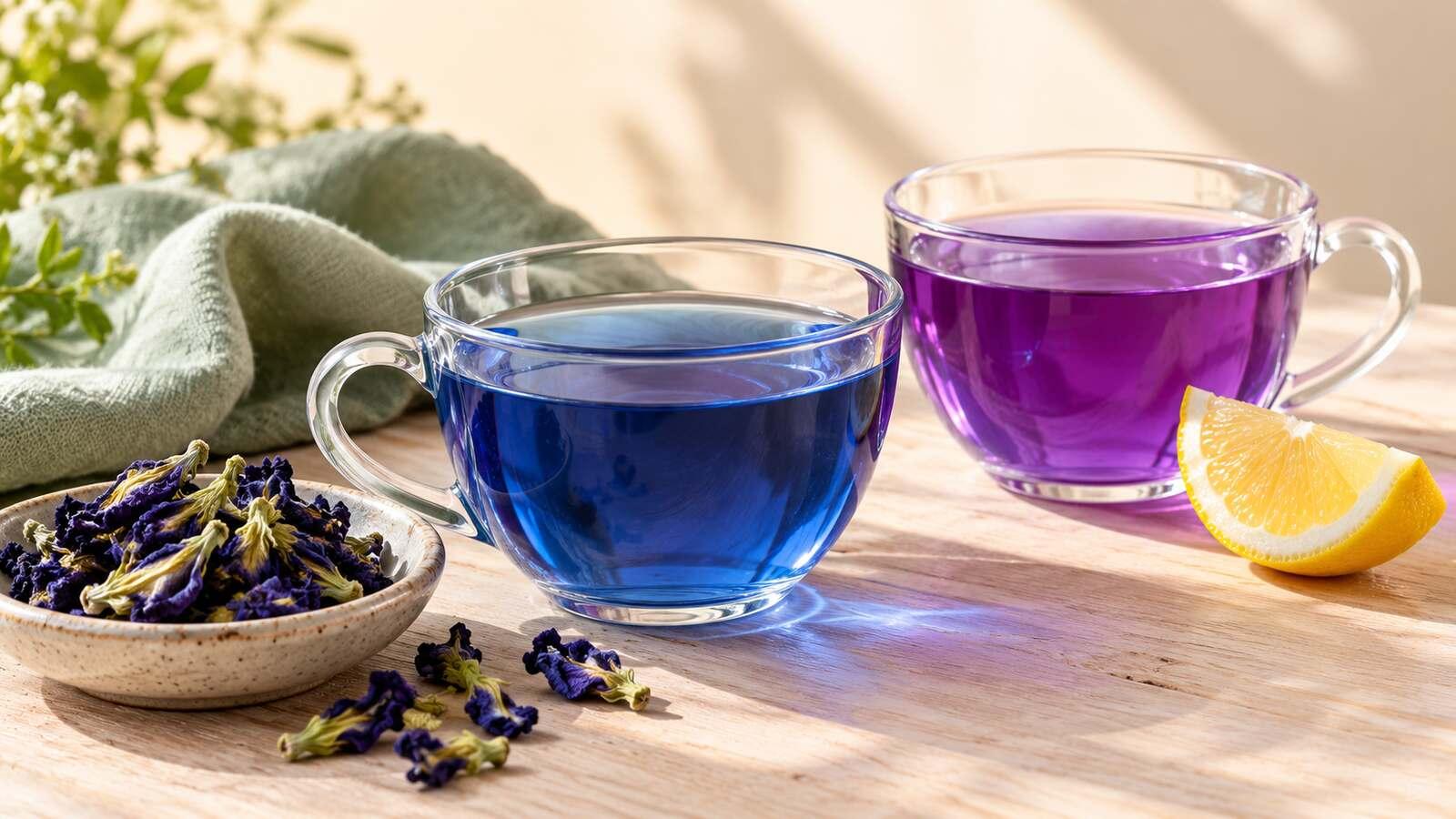
Butterfly pea tea is a blue infusion made from dried Clitoria ternatea flowers sold for food or tea. Its color can change toward purple or pink when you add lemon, which makes a plain-versus-lemon comparison more useful than mixing everything in the pot at once. This page is a drink recipe: measure the flowers and water, taste one plain cup, then add acid to a second portion. It does not promise a health effect from the blue color.
For a first hot batch, use 2 g dried food-grade butterfly pea flowers in 300 ml hot water and strain after 5 minutes. These are this guide's kitchen starting quantities, not a laboratory-derived optimum or a universal producer rule. If your packet gives a method for its flowers, start there. Divide the strained liquid into two 150 ml cups. Leave one plain; add lemon to the other a few drops at a time, stirring and tasting. The matched cups make both the taste and color shift easier to notice.
Choose the right flowers and read the blend label
Buy dried flowers sold for use in drinks or food. An ornamental plant, florist bouquet, or garden flower is not automatically an identified, food-grade ingredient. The blue drink described here uses butterfly pea flowers, not blue dye added to an unrelated tea. The FDA lists butterfly pea flower extract as a color additive for specified foods including teas; that regulatory listing does not prove a therapeutic benefit or certify every package of whole flowers.
Read the full ingredient list. A packet of plain butterfly pea flowers is different from a blend with green tea or black tea leaves. Tea leaves contribute caffeine and may call for their own temperature and timing. This recipe is for the flower-only ingredient. If the product includes tea leaves, use its directions and do not infer caffeine status from the blue color or the word “flower.”
Different brands pack whole flowers and small pieces differently, so a gram scale is more repeatable than a scoop. If you have only a spoon, note whether it is level or heaped and use the same spoon next time. Do not claim that one tablespoon always equals 2 g. The water and flower ratio in this recipe is a place to begin tasting, not a target you must hit for safety or color.
Plain hot recipe, then a matched lemon cup
Use a heat-safe pot, strainer, 2 g flowers, and 300 ml hot water. A 5-minute first steep is common in seller recipes such as the Social Tea House hot and iced guide. Our precise gram and water quantities are written for this page. Keep the same batch for both cups so flower amount, water, and time do not confound the lemon comparison.
- Put 2 g of dried flowers in the pot. Measure 300 ml water and heat it to a hot, just-off-boil temperature. If your product gives a different temperature, follow it first.
- Pour the water over the flowers. Start a five-minute timer as you pour, cover the pot, and then strain completely. Taste a small amount plain before adding anything.
- Pour 150 ml into a first cup and leave it plain. Pour the remaining 150 ml into a second cup.
- Add lemon juice to the second cup a few drops at a time, stirring. Watch for a shift from blue toward violet or pink and taste after each addition. There is no mandatory number of drops: fruit acidity, water, flower product, and personal taste vary.
- If either cup tastes too weak, change one variable next time. Try a little more flower or a slightly longer steep, not both. If it tastes too strong, reverse one change.
The plain cup gives you a baseline. The lemon cup shows what the same infusion tastes like with acid. Sweetener can be added after this comparison, while the drink is still warm enough to dissolve it. If you sweeten only one cup before tasting, you cannot tell which difference came from lemon and which came from sugar. Record the flower mass, water, time, lemon addition, and whether you preferred it plain or acidic.
Why lemon changes the color
Butterfly pea flowers contain blue anthocyanin pigments. The color forms of those pigments depend on the acidity of their surroundings. The University of Florida IFAS explanation describes the extract changing color as pH changes; a spectral study of butterfly pea anthocyanins examines color at different pH conditions. Lemon juice lowers the pH of the drink, so a blue cup can move toward purple or pink. The exact shade is not a fixed pH test in your kitchen.
This is a color and flavor effect, not a health signal. A deeper blue does not establish that one batch has more useful nutrients; a pinker cup does not make it more effective. Lemon quantity, water minerals, flower variety, concentration, and lighting all affect what you see. Do not add alkaline powders to force a different color. For a drink, focus on taste and a food-safe ingredient list.
The plain-versus-lemon comparison is also easier to understand than a layered mocktail. You can see and taste the difference with two small cups made from one batch. If you later want sweetness, fruit, or sparkling water, add one at a time so you know what changed. For a tart red flower drink with a different ingredient, see our hibiscus tea guide.
Hot and iced dilution worksheet
Ice melts into the drink, so pouring a normal-strength hot cup over a full glass of ice can produce a weak final cup. The following are authored household examples with transparent arithmetic, not optimized botanical extraction measurements. Keep the same 2 g flowers and chosen five-minute steep, then change the initial water and final dilution. Aim for roughly 300 ml of finished drink before optional lemon, sweetener, or extra ice.
| Serving | Flowers | Initial hot water | Water added after straining | Approximate finished liquid | What to do |
|---|---|---|---|---|---|
| Plain hot batch | 2 g | 300 ml | 0 ml | 300 ml | Divide into two matched cups |
| Iced concentrate | 2 g | 200 ml | About 100 ml cold water or melted ice | About 300 ml | Strain first; taste as the ice melts |
| Smaller iced trial | 1 g | 100 ml | About 50 ml cold water or melted ice | About 150 ml | Keep the same starting ratio as the iced concentrate |
The iced concentrate starts stronger because the final liquid includes dilution. A handful of ice cubes does not melt to an exact 100 ml every time. If precision matters to you, add measured cold water after straining, chill the drink, then serve over a little ice. If you pour concentrate over ice, taste when some ice has melted and adjust. Never count unmelted cubes as water already in the drink.
For the lemon version, divide the finished iced batch into two portions and add lemon to only one. Add the acid after straining so you can compare it with the same blue baseline. If you pour lemon juice over one side of a tall glass, the color may change in a gradient until you stir; the whole cup's flavor will not be uniform until mixed. Our iced tea guide explains why hot concentrates need a dilution plan.
Adjust taste without chasing the color
Butterfly pea flower tea can taste mild and earthy. If it feels too faint, first check whether you used the labeled flower rather than a colored blend, whether the flowers were fully wet, and whether the final iced volume was larger than planned. On the next batch, keep the water and time the same and try a little more flower. If the result is harsh or dull, reduce the flower amount or steep time one at a time. Stronger color is not necessarily better flavor.
Lemon adds tartness as well as the color shift. Add it by taste, not until the cup reaches an exact pink. You can add a small amount of honey or sugar after comparing the plain and lemon cups. For an iced drink, dissolve sugar in the warm concentrate before adding cold water and ice. If you want a lighter drink, use more water and note the final volume so you can reproduce it.
Store prepared tea in a clean covered container in the refrigerator and make only what you expect to drink soon. Do not leave wet flowers or prepared drink sitting at room temperature all day. Strain out flowers before storage; a floating flower can keep extracting and make the next glass taste different. The loose-leaf tea without an infuser guide offers simple straining options if you do not own a dedicated tea pot.
Common questions
Does butterfly pea tea have caffeine? Plain butterfly pea flowers do not contain tea leaves. A mixture with green or black tea does contain tea-leaf caffeine. Check the full ingredients, not the blue color.
How many flowers should I use? This page uses 2 g per 300 ml for a first hot batch. Flower sizes vary, so counting flowers or converting to tablespoons is unreliable across products. Follow your packet if it gives a specific method, then record your own preference.
Why did lemon turn it purple rather than pink? The shade depends on acidity and concentration. Add lemon in small steps and stir. The exact color is not a calibrated pH measurement.
Can I use fresh flowers? This recipe uses dried butterfly pea flowers labeled for food or tea. It does not establish that garden or florist flowers are suitable for consumption.
Can I make it iced without a weak result? Yes. Brew a smaller hot volume as a concentrate, strain, and account for the cold water or melted ice in the final volume. The worksheet gives a 200 ml + about 100 ml example.
Time the steep in Tea Timer, then write down the actual water, flower mass, and lemon amount you liked. A repeatable plain cup makes the next color-changing cup a deliberate recipe rather than a guess.
Related Articles
Chrysanthemum Tea: A Measured First Cup and Timing Guide
Brew chrysanthemum tea with a measured flower-to-water ratio, then use a simple strength worksheet to adjust steeping time, iced dilution, and blends.
Osmanthus Tea: Flowers, Tea Blends and How to Brew Each
Learn what osmanthus tea contains, brew pure flowers with a measured seller recipe, and get starting temperatures and times for green, oolong and black blends.
London Fog Tea Latte: A Hot and Iced Earl Grey Recipe
Make a London Fog tea latte with Earl Grey, milk and vanilla. Use clear hot and iced ratios, choose your sweetness, and fix a weak, bitter or foamy cup.