Yellow Tea: What It Is, How It Is Made and How to Brew It
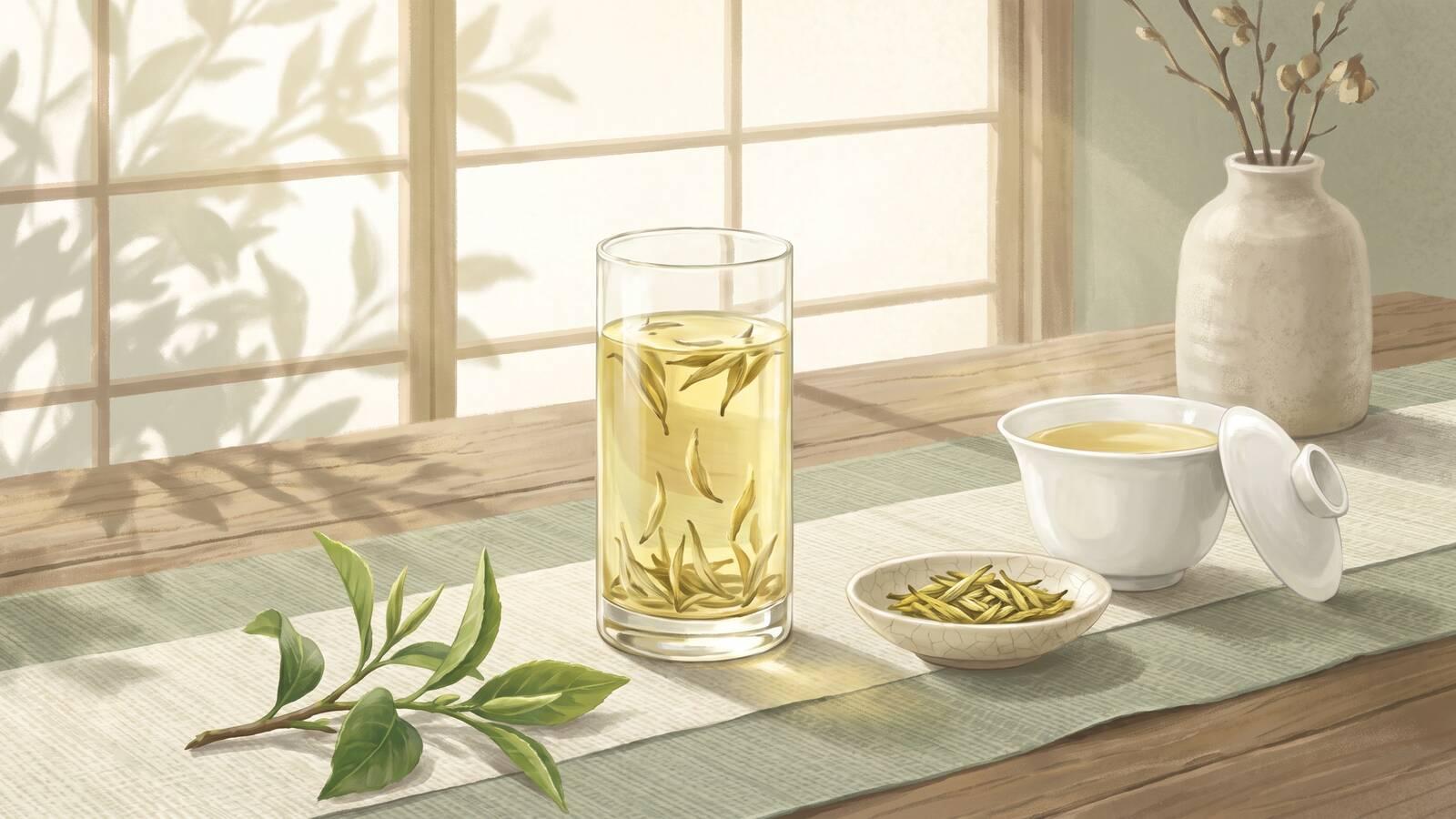
Search for yellow tea and the shop results are a mixed bag: a few small tins of Chinese bud tea, and next to them a familiar yellow box of Lipton. Only one of those is yellow tea. The other is black tea in a yellow package, and it brews completely differently.
Yellow tea is a real category, one of the six classical Chinese types, and also the least known of them. It starts life exactly like green tea, then takes one extra, slow step that changes the cup. This guide explains that step, names the teas that actually belong to the category, sorts out the ones that only borrow the word, and gives brewing numbers for yellow and green tea side by side so you can see where they differ.
What is yellow tea?
Yellow tea, huangcha in Chinese, is a lightly processed tea from China. A review in Food Research International describes it as similar to green tea in many ways: the first stages of production are the same, but yellow tea adds a procedure called sealed yellowing that removes green tea's grassy smell and gives a mellower taste (Xu et al., 2018). The same review notes that yellow tea is much less known and less studied than the other types.
It comes from the same plant as every other true tea, Camellia sinensis. As our overview of the six types of tea explains, the category is a decision about processing, not a different plant. For yellow tea, that decision is a pause.
Men huang: the sealed yellowing step
The extra step is called men huang (闷黄), usually translated as "sealed yellowing" or "smothering". After the kill-green heating step, the warm, still-damp leaf is wrapped or piled and left to rest instead of going straight to drying. A 2024 review in Critical Reviews in Food Science and Nutrition calls yellowing the most important step for yellow tea's taste, aroma and color, and lists what controls it: temperature, moisture content, duration and ventilation (Feng et al., 2024). Producers can do it before or after the leaf is rolled (Sun et al., 2024).
What changes in the cup is measurable. In a trial that yellowed the same leaf for anywhere from 0 to 13 hours, longer yellowing reduced umami and green-tea aroma and increased sweet taste, mellow taste and sweet aroma. The chemistry moved the same way: catechins, flavonol glycosides and caffeine went down, and some amino acids went up (Fan et al., 2022). A second study found the same pattern for amino acids, soluble sugars, polyphenols and caffeine (An et al., 2019). The Feng review attributes the drop in astringent compounds to the combined effect of heat, moisture and enzyme reactions during yellowing.
In plain terms: yellow tea is green tea with the sharp edges sanded off. Less grass, less bite, more sweetness and body. That is the entire reason to seek it out, and it is also why it needs slightly different handling in the kettle.
The real yellow teas
Most yellow teas are named after the place in China they come from. The Feng review groups the category by leaf: bud and small-leaf yellow teas, with a fresh, sweet aroma, and large-leaf yellow teas, which are roasted and taste of toasted, crispy rice. The names you are most likely to meet:
- Junshan Yinzhen (Jun Shan Silver Needle), from Junshan Island in Hunan: a bud-only yellow tea. See our Jun Shan Yin Zhen profile.
- Meng Ding Huang Ya (Meng Ding Yellow Buds), from Mount Meng in Ya'an, Sichuan: buds and young leaves. See our Meng Ding Huang Ya profile. A 2026 study of Mengding bud yellow tea traced its aroma shift from grassy to sweet and umami to the yellowing stage.
- Huoshan Huangya, from Anhui province (Yellow tea, Wikipedia). Huoshan is also known for a roasted large-leaf yellow tea, which appears in research under that name (Li et al., 2025).
- Mogan Huangya, from Zhejiang (Yellow tea, Wikipedia).
If you want to browse what we cover, the yellow tea category lists both profiles. Because the category is small and the step is invisible on the label, the word yellow on a packet tells you less than you might hope. That brings us to the naming traps.
Teas called yellow that are not yellow tea
This is where most confusion comes from. The test is simple: was the leaf killed green and then given a sealed yellowing rest? If not, it is not yellow tea, whatever the box says.
| Name on the label | What it actually is | How to brew it |
|---|---|---|
| Lipton Yellow Label | A black tea; Lipton's own product page calls it Yellow Label black tea. The yellow is the packaging. | As black tea: near-boiling water, 3-5 minutes. See black tea brewing essentials. |
| "Yunnan Yellow" teas | Sold as yellow tea by some shops, but one seller describes its processing as similar to black tea: sun withering, rolling, oxidation and drying, with shorter withering and oxidation. No sealed yellowing step is described. | Follow the seller: that one recommends 85-90°C water and gongfu-style steeps. Do not use a delicate yellow tea recipe by default. |
| Korean hwangcha (황차) | A partially oxidized Korean tea. Tea writer Tony Gebely notes it does not go through a kill-green step like traditional yellow tea, and one Korean tea expert he quotes says simply that "hwangcha is not a yellow tea" (Tea Epicure). | Closer to an oolong or a light black tea; start with the seller's directions. |
| Yellow-colored herbal blends | A tisane whose color comes from herbs or flowers, not from Camellia sinensis. | Read the ingredients and follow the herbal brewing guide. |
The Lipton case matters most for brewing. If you treat a black tea bag like a delicate bud tea, at 75-80°C for two minutes, you get a thin, sour cup. If you treat a real yellow tea like Lipton, with boiling water for five minutes, you flatten exactly the sweetness you paid for. Getting the category right is the first step of the recipe.
How to brew yellow tea, side by side with green
Yellow tea sits close to green tea in the kettle, but it is a little more forgiving and often rewards a slightly longer first steep. The table uses the presets in the Tea Timer app for two yellow teas and two green teas, all Western-style in about 200 ml of water. These are the numbers on each tea's brew page: Meng Ding Huang Ya, Jun Shan Yin Zhen, Dragon Well and Sencha.
| Steep | Meng Ding Huang Ya (yellow) | Jun Shan Yin Zhen (yellow) | Dragon Well (green, pan-fired) | Sencha (green, steamed) |
|---|---|---|---|---|
| Leaf | 3 g per 200 ml | 3 g per 200 ml | 3 g per 200 ml | 4 g per 200 ml |
| 1st | 80°C, 2 min | 75°C, 3 min | 80°C, 2 min | 70°C, 1 min 30 sec |
| 2nd | 80°C, 2-3 min | 75-80°C, 3-4 min | 80°C, 2-2.5 min | 75°C, 45 sec |
| 3rd | 85°C, 3 min | 80°C, 4-5 min | 80°C, 3 min | 80°C, 30 sec |
| 4th (optional) | 85°C, 4 min | 85°C, 5 min | rarely worth it | 85°C, 60 sec |
Three things stand out when you read across:
- The yellow teas never go hotter than about 85°C. Like green tea, they lose their point in boiling water. The difference is that a yellow tea comes out softer at the same temperature, because yellowing has already lowered the bitter, astringent compounds.
- Yellow tea resteeps get longer and a little warmer, like the pan-fired Dragon Well and unlike sencha. Steamed Japanese greens are fine and open fast, so their second steep is shorter. Whole buds open slowly over several infusions. Our green tea brewing guide explains the two green patterns in detail.
- The bud tea takes the longest. Jun Shan Yin Zhen is all buds and gets the coolest water and the longest first steep. Traditionally it is brewed in a tall glass so you can watch the buds rise and sink.
In a gaiwan. The temperatures stay the same. What changes is the ratio: gongfu brewing uses far more leaf for the water and steeps of seconds rather than minutes, so start short and lengthen each round. Our gongfu tea guide explains the method. These gaiwan notes are general guidance, not an app preset; for any specific tea, the seller's directions come first.
If your yellow tea tastes like plain green tea, the leaf may be lightly yellowed, or the water may be too hot. Drop 5°C before blaming the tea. If it tastes flat and dull, it may be old: like other lightly processed teas, it is best stored airtight, away from light, heat and smells (how to store tea properly). Tea Timer holds each step of the resteep plan, so the second and third cups come out as carefully as the first; download it here.
Caffeine, health claims and buying
Yellow tea has caffeine. The lab trials above found that longer yellowing reduced caffeine compared with less yellowed leaf (Fan et al., 2022; An et al., 2019), but those are research samples, not the tin in your kitchen. No reliable per-cup figure exists for yellow tea as a category, so treat it like a green tea: caffeinated, with the amount set mostly by how much leaf you use and how long you steep. Our caffeine in tea guide covers those variables.
Health claims deserve the same care. The reviews summarize antioxidant and metabolic effects, but most of that work comes from lab and animal studies, not from people drinking yellow tea. Drink it for the flavor.
When buying, look for three things on the seller's page: a named tea from a real yellow-tea region, a description of the yellowing step, and a harvest date. A tin that only says "yellow tea" with no origin, or a price that looks like everyday green tea, is worth a question to the seller before you order.
Frequently asked questions
Is yellow tea the same as green tea?
No, but it is close. Both start with the same kill-green step. Yellow tea then adds a sealed yellowing rest that lowers grassy and astringent notes and makes the cup sweeter and mellower (Xu et al., 2018). You brew it at similar temperatures, usually with a slightly longer steep.
Is Lipton Yellow Label a yellow tea?
No. Lipton calls Yellow Label a black tea. Brew it with near-boiling water like any black tea bag.
How do I brew yellow tea?
Start at 75-80°C with about 3 g of leaf per 200 ml. Steep 2 minutes for a bud-and-leaf tea such as Meng Ding Huang Ya, or 3 minutes for an all-bud tea such as Jun Shan Yin Zhen, then lengthen each resteep slightly.
What does yellow tea taste like?
Softer and sweeter than green tea, with less grassiness and bitterness. Researchers describe bud and small-leaf yellow teas as fresh and sweet, and roasted large-leaf yellow teas as toasty, with a crispy-rice note (Feng et al., 2024).
Does yellow tea have less caffeine than green tea?
Sometimes slightly, because yellowing reduced caffeine in lab trials, but there is no dependable per-cup difference you can count on. Treat it as caffeinated.
Related Articles

Longjing (Dragon Well): The Complete Guide to China's Famous Green Tea
Longjing (Dragon Well) is China's most famous green tea. What pan-firing does, how to brew it at 80°C, and how to buy real West Lake leaf, not tourist tins.

Jasmine Tea: The Complete Guide to China's Most Beloved Scented Tea
Jasmine tea is one of the most popular teas in the world and one of the most faked. What real jasmine tea actually is, scented vs flavored, the grades, and how to brew it.
Bancha Tea Guide: Taste, Brewing and How It Differs from Sencha
Meet bancha tea and learn how it differs from sencha, kukicha and hojicha, with a practical brewing example and clear limits on claims about caffeine levels.