Kabusecha Tea Guide: Shade, Taste and a Measured First Brew
 Ivan Terekhin
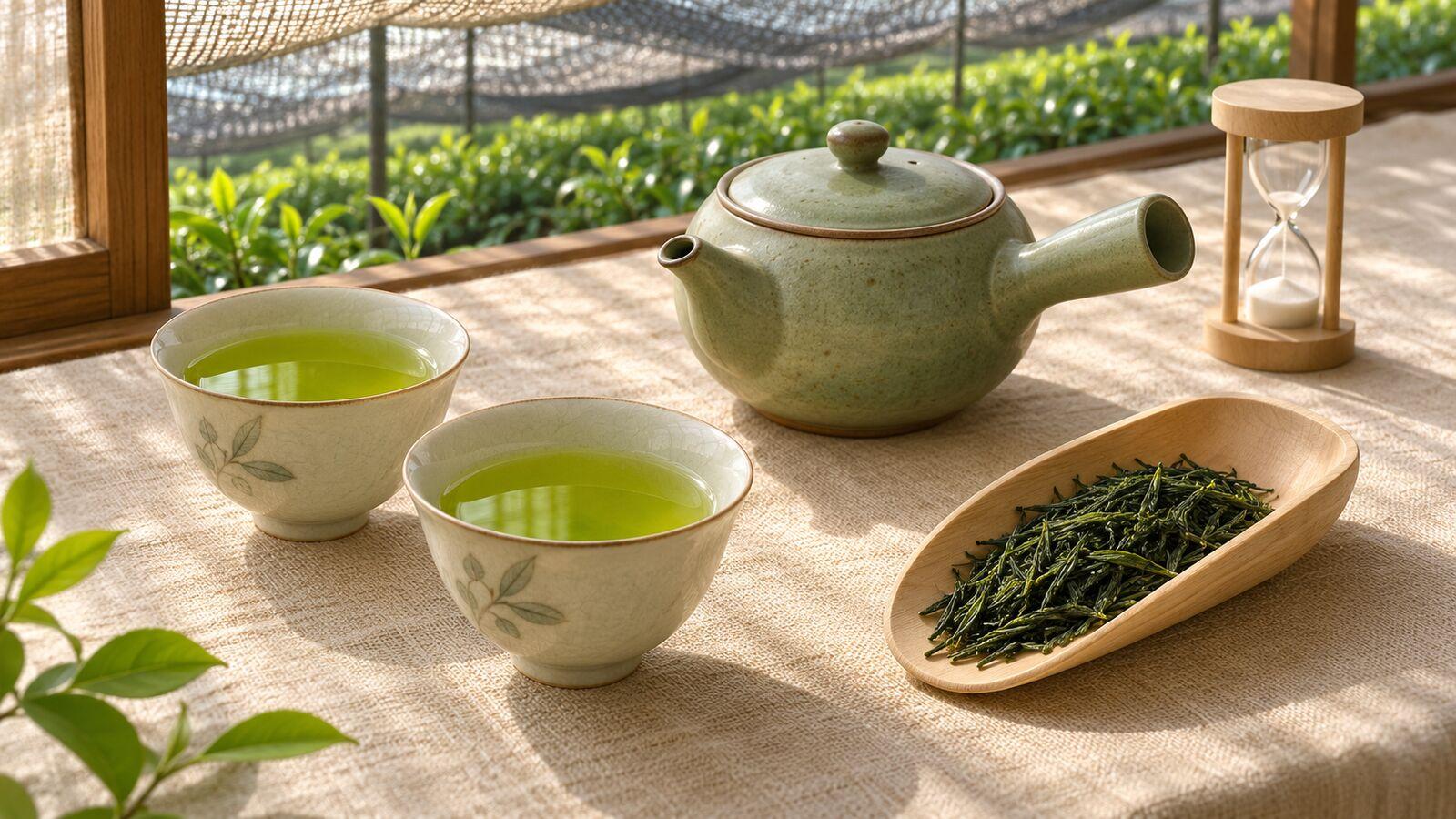
Kabusecha is Japanese green tea made from leaves covered before harvest. Japan's Ministry of Agriculture, Forestry and Fisheries describes it as processed in the same way as gyokuro, but shaded for fewer days. The name points to cultivation, not a blend made by mixing sencha with gyokuro.
For the first cup, follow the packet's directions and record the actual leaf amount, water volume, temperature and time. This guide explains where kabusecha fits, works through a producer's brewing example and shows how to fill in an important missing detail: what “one cup” means in your own teaware.
What the shade description tells you
In its account of Uji tea, MAFF distinguishes open-grown sencha from covered teas, including kabusecha and gyokuro. Its description connects kabusecha's shorter covering period with a flavour between gyokuro-like richness and a refreshing sencha-like finish. Those are useful category descriptions, not a promise that every bag tastes identical.
The tea maker Nakamura Tokichi describes a 7-to-10-day covering period, compared with a longer period for gyokuro. Treat that as the maker's explanation of the style, rather than a universal label rule that overrides a producer's own information. Harvest, cultivar and processing details can still distinguish two products sold as kabusecha.
When comparing packets, look for a named producer or product, the origin given on the label and a brewing recipe. Keep the full product name in your notes. “Kabusecha” alone is a category, so using that single word for every bag can hide which tea produced the cup you liked.
Kabusecha, sencha and gyokuro: keep the questions separate
| Tea name | The category distinction to remember | Where to read more |
|---|---|---|
| Sencha | The MAFF description uses open-grown leaves, steamed, rolled and dried | Sencha guide |
| Kabusecha | Covered before harvest for a shorter period than gyokuro | This guide focuses on its own first-brew workflow |
| Gyokuro | Covered longer before harvest in the cited description | Gyokuro guide |
Source for the cultivation and processing distinctions: MAFF's Uji tea account. The table is not a ranking from worse to better. Choose by the product information and the cup you want to explore, rather than assuming a category name settles your preference.
For a direct comparison of the two neighbouring styles, the sencha versus gyokuro article already owns that question. Kabusecha does not need to become another version of that comparison; the useful next step here is preparing a repeatable cup from the bag in front of you.
A producer's brewing example, read precisely
Hagimura's Japanese-tea brewing sheet gives a kabusecha example with water cooled to approximately 60–70°C, 3 g of leaf per cup and a first infusion of 100 seconds. One hundred seconds is 1 minute 40 seconds. The sheet later describes a 30-second second infusion.
The source does not give a fixed millilitre capacity for the cup in that example. Do not silently convert its “cup” into a large mug or a particular national measuring cup. Measure your vessel, and prefer the packet's own volume-based instructions if available.
| Detail in the example | What to keep | What still needs your attention |
|---|---|---|
| 3 g per cup | The stated leaf amount per serving | The actual water volume in your cup |
| 60–70°C | A cooled-water starting range | The temperature you actually choose and measure |
| 100 seconds | Set the timer to 1:40 | Start timing at a consistent point in the pour |
| 30-second second infusion | Label it as infusion two | Do not compare it directly with a first infusion without noting that difference |
This is one producer's example, not a requirement for every kabusecha. Nakamura Tokichi also describes adjusting brewing to emphasise different flavour qualities. Your own packet may give another recipe. The important part is knowing which recipe you are following, rather than combining pieces from several guides without recording the change.
Measure the cup before scaling the leaves
Suppose you decide to test the cited 3 g-per-cup example with your own 100 mL serving. That water volume is an explicit choice for this worked example, not a value supplied by Hagimura. Your recorded ratio is then 3 g per 100 mL.
At that chosen ratio, two 100 mL servings need 6 g for 200 mL. A 150 mL serving would use 4.5 g. The arithmetic keeps the ratio constant; it does not prove that this ratio is the right one for every packet or palate.
Write the measured serving volume beside the recipe so the next cup can be compared honestly. If you instead use 3 g in a 300 mL mug, you have chosen a different ratio. Neither number should disappear into the vague instruction “one teaspoon for one cup.”
For more examples of scaling measured quantities, use the tea-to-water ratio guide. Once the ratio is written down, you can decide whether you like it rather than trying to reconstruct it afterward.
Make one controlled comparison
Choose a fixed product, measured ratio and first-infusion time. If your packet allows a temperature range, compare two points in that range while holding the other details steady. For the cited 60–70°C example, you could compare 60°C with 70°C at the same 100-second infusion time.
Treat that as a tasting exercise, not an experiment proving a universal chemical rule. Record which cup you preferred and how you would describe it in your own words. You can note a rounder, sharper, lighter or more intense impression without forcing the cup to match a seller's tasting vocabulary.
Use Tea Timer to keep the chosen infusion time visible. The timer makes that part repeatable; it does not measure leaf mass or water temperature. When the time ends, pour the liquid away from the leaves and use the same pouring approach for both trials.
If you are serving several cups, Hagimura's sheet describes pouring a little into each cup and then reversing the order. This spreads the pour across the cups rather than filling one completely before the next. Use a method you can repeat, and label which preparation you are tasting.
Record the next infusion separately
The same leaves have already been used, so “second infusion” belongs in the record. Do not compare it with yesterday's first infusion as though only the temperature changed. The resteeping guide covers this broader distinction.
A compact note can read: product, infusion number, water volume, temperature, time and preference. You do not need a paragraph for every cup. “Second infusion, 30 seconds, preferred the first” is useful if the preparation details are also saved.
If you change the time on a later infusion, write the actual time rather than the original packet range. A timer history or notebook is only as useful as the preparation it describes.
Questions about kabusecha
Is kabusecha a sencha-and-gyokuro blend?
The MAFF description identifies a cultivation and processing style using covered leaves. Calling its flavour “between” two styles does not mean those finished teas were blended together.
Does every producer use the same number of shade days?
Use the producer's information for the product you buy. The cited sources describe shorter covering than gyokuro, while Nakamura Tokichi gives a 7-to-10-day example. This guide does not establish a universal legal threshold for every kabusecha label.
Is 100 seconds the same as a minute and a half?
No. A minute and a half is 90 seconds. Set 100 seconds as 1:40 if you are following that exact example. Recording the actual time prevents a small wording difference from becoming an unnoticed recipe change.
What if I prefer the hotter or stronger cup?
Keep the version you enjoy and record it. The purpose of a measured comparison is to find a preparation you can repeat, not to pass a taste test with one approved answer.
Start with the actual packet, measure what your cup holds and use one clearly recorded recipe. Kabusecha becomes easier to understand when its name, its shade description and your brewing choices each have their own place in the notes.
Related Articles
Bancha Tea Guide: Taste, Brewing and How It Differs from Sencha
Meet bancha tea and learn how it differs from sencha, kukicha and hojicha, with a practical brewing example and clear limits on claims about caffeine levels.
Kukicha Tea: Taste, Caffeine, and How to Brew It Well
Explore kukicha, Japan’s stem tea: how green and roasted versions taste, what affects caffeine, how to brew a cup, and how it differs from hojicha and sencha.

Sencha vs Gyokuro: Which Japanese Green Tea Should You Choose?
Choose sencha or gyokuro by taste, serving style, brewing attention, and value. Compare everyday freshness with concentrated umami without health promises.