Keemun Tea Guide: Qimen Black Tea, Taste and Brewing
 Ivan Terekhin
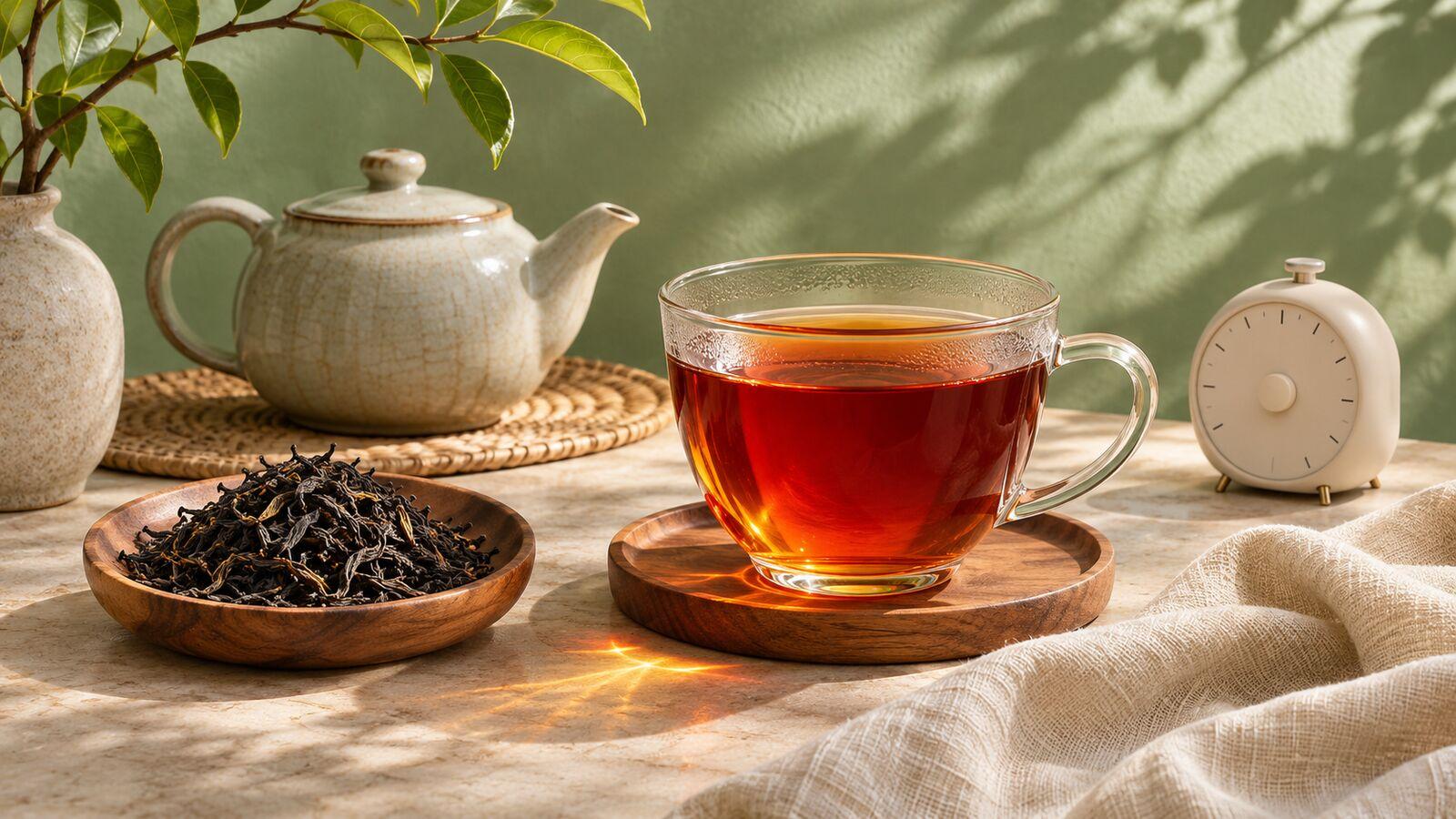
A packet says Keemun, another says Qimen, and a third adds Mao Feng. Before choosing a brewing temperature, check whether you are comparing different spellings or different products. Keemun is the familiar English name for black tea associated with Qimen in China's Anhui province. The Chinese government's account of tea tourism in Qimen uses Qimen and Keemun for the same tea name.
That tells you where the name comes from, but it does not give every packet one flavour or one recipe. This guide uses two actual seller recipes to show the variation, then gives you a controlled way to adjust your own cup. You do not need to recognise an elaborate list of tasting notes before deciding whether you enjoy it.
What to look for on a Keemun label
Start with the exact product name, the stated origin, whether anything has been added, and the brewing directions. Keep those details together. A name such as Mao Feng or a seller's grade label helps identify the product you bought; it does not replace information about that specific batch.
For a concrete example, TeaVivre's Keemun Mao Feng page identifies Qimen County in Anhui as its origin and describes floral, chocolate and fruity notes. Those are the seller's descriptions of that tea, not a universal definition of Keemun and not a tasting result measured by us.
If you want to compare two bags, label your notes with their full names rather than simply “Keemun.” Otherwise a different harvest or product can look like a change in your brewing skill. Take a photograph of the directions before throwing away the outer packaging.
Also distinguish an unflavoured tea from a scented or blended product. If a label lists jasmine or another added ingredient, that information belongs beside the name in your notes. The goal is not to judge one version as more legitimate; it is to avoid expecting two different products to taste identical.
Two real recipes show why the packet matters
The two recipes below come from one seller's separate product pages. They are useful examples of product-specific instructions, not a recommendation to buy either tea. Read the current directions on your own packet first.
| Product example | Leaf amount | Water | Temperature | First infusion |
|---|---|---|---|---|
| TeaVivre Superfine Keemun Mao Feng | 2.5 g | 355 mL | 90°C | 3 to 5 minutes |
| TeaVivre Superfine Keemun Fragrant | 2.5 g | 355 mL | 85°C | 1 to 3 minutes |
Sources: Mao Feng product directions and Fragrant product directions. The different temperatures and time ranges are a good reason not to treat “black tea” as one fixed timer setting. They also show why comparing a mug infusion with a small-vessel, high-leaf recipe without checking quantities is confusing.
If your packet has its own recipe, start there. If it gives a range, choose one point in that range and write down what you used. “About three minutes” is hard to reproduce if you were actually answering messages for five.
Scale a recipe without changing its ratio
Suppose you are following the first example but your working water volume is 250 mL rather than 355 mL. Keep the same leaf-to-water ratio:
2.5 g × 250 ÷ 355 = about 1.76 g of leaf.
That is a scaled version of the cited recipe, not a new universal Keemun dose. If your scale only reads tenths of a gram, record 1.8 g and use that consistently for the comparison. Do not pretend to measure hundredths with a scale that cannot display them.
The corresponding calculation for 500 mL is 2.5 × 500 ÷ 355 = about 3.52 g. Keep the temperature and chosen infusion time unchanged for the first attempt. Scaling the water, increasing the leaves and extending the time together would change three things at once.
For a broader explanation of ratios across tea styles, use the tea-to-water ratio guide. Here the useful point is practical: measure the water you will actually brew with, rather than assuming the number printed on the bottom of a large mug is your usual serving.
Make the first cup repeatable
Set out the tea, brewing vessel, strainer, cup and timer before pouring. Measure the leaf and water, use the temperature chosen from the packet, and start the timer at the same point in your pouring routine each time. When the time ends, separate the liquid from the leaves so the next part of your tasting is not also an unrecorded extension of the infusion.
Write down the recipe before describing the flavour. A short line is enough: product, leaf mass, water volume, water temperature and time. If you changed the water source or vessel, note that too. You are building a record that another version of you can follow tomorrow.
Tea Timer is useful for keeping the infusion time consistent while you work on the other variables. Use the time appropriate to the product and your chosen trial. A timer handles the clock; it cannot determine the leaf grade, measure your water temperature or decide which taste you prefer.
The black-tea brewing guide covers the general workflow. Keep this first Keemun cup simple enough that you can tell what you would change next.
A three-cup comparison that changes one thing
You do not need three cups at once. These can be three separate sessions with the same packet and measured setup. The example stays within the Mao Feng seller's cited 3-to-5-minute range; it is a suggested comparison, not a claim that one time wins.
| Trial | Leaf and water | Temperature | Time | Question for your notes |
|---|---|---|---|---|
| A | Same measured ratio | 90°C | 3 minutes | Is this a cup I would happily repeat? |
| B | Same as A | 90°C | 4 minutes | What changed compared with A? |
| C | Same as A | 90°C | 5 minutes | Do I prefer this, or did A or B suit me better? |
Use your own words: light, strong, drying, round, fragrant, flat. “I prefer B” is a useful conclusion even if you cannot identify a flower or fruit. If you add milk or sugar, first record whether all three cups received the same addition. Otherwise you are comparing both the infusion and the additions.
If you want to explore temperature next, keep your preferred time and measured ratio fixed. One change per comparison makes the notes easier to interpret. It does not guarantee identical cups, because your measurements and ingredients still have ordinary variation.
Troubleshoot the setup before blaming the tea
The cups vary even with the same timer. Check whether the water volume, leaf measure or point at which you started timing changed. A heaped spoon and a level spoon are different inputs. So are draining the vessel promptly and leaving the leaves in the cup while you answer a call.
The recipe seems far too strong or too light. Check the units and method first. A small-vessel recipe may use much more leaf per millilitre than a mug recipe. Do not transplant its leaf quantity into a large mug while keeping only one part of the original directions.
You cannot reproduce a cup you liked. Write the full product name and recipe next time. “The red packet, roughly a spoon, until it looked ready” gives you very little to repeat. Use the tea-tasting guide if you want a more detailed note format.
You want another infusion. Follow any repeat-infusion guidance supplied with the tea, and label the infusion number. Do not compare a first infusion from one bag with a second infusion from another as though only the product changed. The resteeping guide covers that separate experiment.
Questions about Keemun
Are Keemun and Qimen different teas?
They are different renderings of the name associated with Qimen black tea. A packet's extra product name or added ingredients can still describe a different item. Read the full label, not just the shared word.
Must every Keemun be brewed at boiling temperature?
The two checked seller recipes above use 85°C and 90°C. Follow the specific product's directions and make adjustments deliberately. A generic rule for every black tea would miss that variation.
Do I have to drink it without milk?
No. Decide what you enjoy, and keep additions consistent when comparing recipes. The point of the first plain taste is to give you a reference, not to create a rule about how you must drink tea.
Start with the packet, measure a repeatable cup and use the timer to change one variable at a time. Your best Keemun recipe is the one you can describe clearly enough to make again.
Related Articles
Lapsang Souchong: The Complete Guide to Smoked Black Tea
Lapsang Souchong is the pine-smoked black tea from Wuyi. What it tastes like, smoked vs unsmoked, how to brew it, caffeine, food pairings, and buying tips.
London Fog Tea Latte: A Hot and Iced Earl Grey Recipe
Make a London Fog tea latte with Earl Grey, milk and vanilla. Use clear hot and iced ratios, choose your sweetness, and fix a weak, bitter or foamy cup.
Yellow Tea: What It Is, How It Is Made and How to Brew It
Yellow tea is green tea with a sealed yellowing rest. What men huang does, the few real yellow teas, the names that are not yellow tea, and how to brew it.